AI SEARCH
Ads in ChatGPT and Google AI Overviews: What Small Businesses Need to Know
Ads now appear beside AI answers. What that means for small businesses, and why being cited still matters more.
ESTIMATED READ TIME: 11 MINUTES
Want an outside read on whether your ads are earning their keep?
For two decades, search advertising followed a simple pattern: someone typed a query, a page of links appeared, and a few of those links were ads. That pattern is changing fast. More people now get answers from AI: Google’s AI Overviews at the top of search results, Google’s conversational AI Mode, and chat assistants like ChatGPT.
Naturally, business owners are asking us the same questions. Can I advertise inside these AI answers? Will AI search take away the clicks I get from Google? Do I need a new budget for this, or will my current campaigns cover it?
This guide answers those questions in plain English. It explains where ads can appear in AI search today, how they are bought, what you can and can’t control, and how paid ads fit with the organic work that gets your business recommended by AI in the first place. Because these products change often, we link to the official help pages so you can check the latest details yourself.
Key takeaways
- Google can show ads above, below and, in eligible markets, within AI Overviews.
- You don’t buy them separately; they come from existing Search, Shopping and Performance Max campaigns.
- You cannot target or opt out of AI Overview placements, and Google does not currently report them separately.
- ChatGPT shows labeled ads below responses for users on its Free and Go plans.
- Ads do not change ChatGPT’s answers.
- Businesses can apply to advertise in ChatGPT through OpenAI’s Ads Manager in countries where it is available.
- Paying for an ad next to an AI answer is not the same as being recommended in the answer.
- That part is earned through SEO, content and reviews.
Why AI Search Changes Advertising for Small Businesses
Traditional search results gave people a list of options and let them choose. AI search often gives them an answer first. For a small business, that creates two separate opportunities:
- Earned visibility: being mentioned, cited or recommended inside the AI answer itself.
- Paid visibility: having a labeled ad appear next to, below or within the answer.
Both matter, and they work very differently. The rest of this guide focuses on the paid side, then explains how it connects to the earned side. If you want to understand the organic side first, read our guide on how to make your business show up in ChatGPT and Google AI answers.
Where Ads Appear in AI Search Today
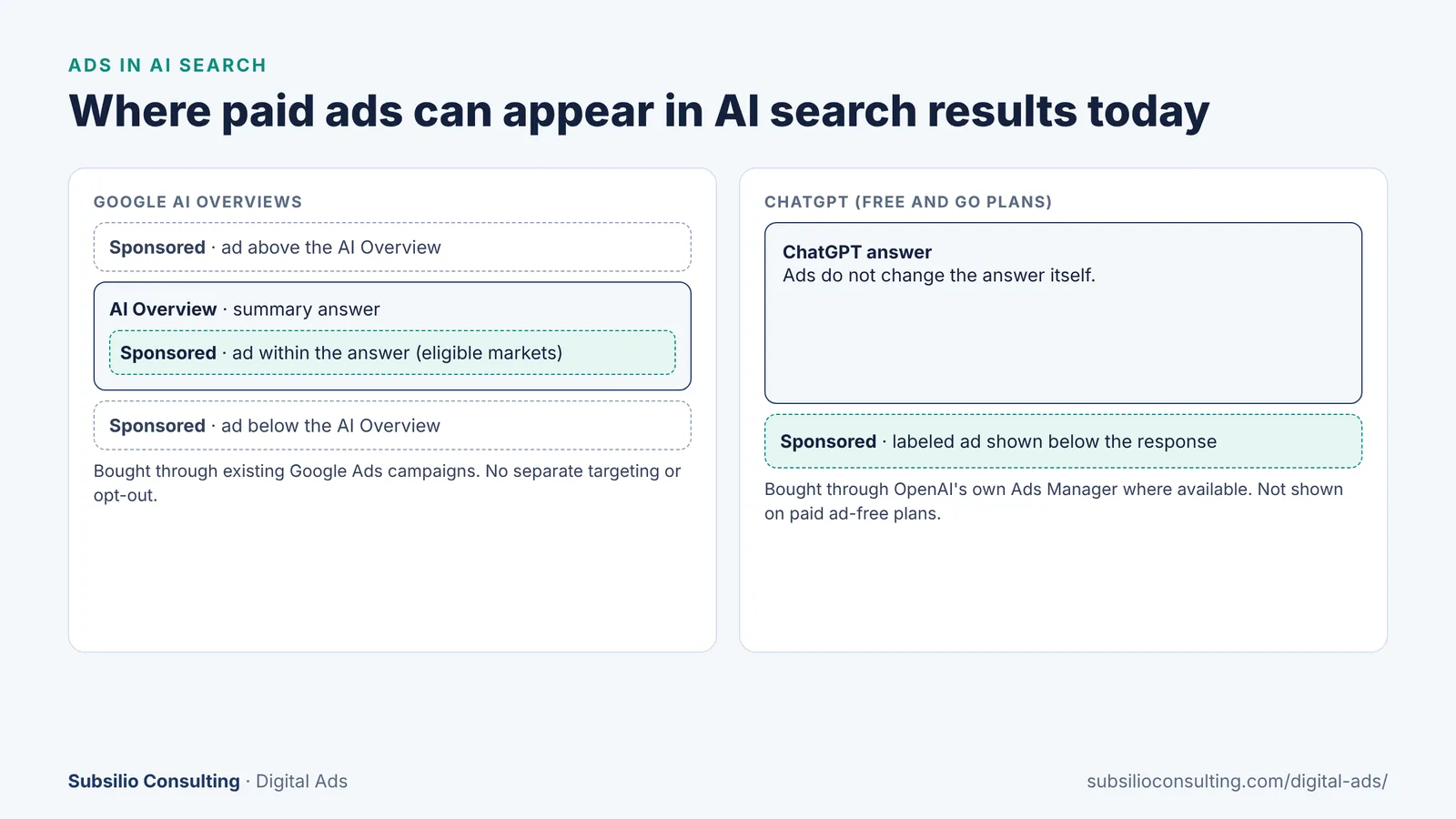
Where paid placements can appear in Google AI Overviews and ChatGPT.
Ads in Google AI Overviews
According to Google’s help article About ads and AI Overviews, ads can appear above or below AI Overviews in all markets where AI Overviews are available. Ads can also appear within AI Overviews when they are relevant to both the search and the content of the AI Overview.
The key details from Google’s documentation:
- Which campaigns are eligible: existing Search, Shopping, Performance Max and App campaigns can show above or below AI Overviews. Text and Shopping ads from Search, Shopping and Performance Max campaigns can show within AI Overviews.
- Where ads within AI Overviews are available: in English, on mobile and desktop, in a list of countries that includes the US, Canada and Australia.
- Restricted categories: Google does not show ads within AI Overviews for certain sensitive verticals, including healthcare, finance, gambling, alcohol and politics.
- Targeting and opting out: you cannot directly target AI Overview placements, and you cannot opt out of them. Google decides placement using its existing systems.
- Reporting: Google says it does not currently offer segmented reporting for ads shown within AI Overviews. They are reported as top ads.
Ads in Google AI Mode
AI Mode is Google’s conversational search experience, where people ask follow-up questions in a chat-like format. Google has been testing ad formats there. In its 2026 outlook on digital advertising and commerce, Google described testing a shopping ad format in AI Mode, clearly marked as sponsored, and similar formats in other categories such as travel.
For a local service business, the practical takeaway is the same as for AI Overviews: these placements are reached through your existing Google Ads campaigns, not a separate product you buy.
Ads in ChatGPT
OpenAI began testing ads in ChatGPT in the United States in February 2026. According to OpenAI’s help article Ads in ChatGPT:
- Who sees ads: users on the Free and Go plans. Plus, Pro, Business, Enterprise and Edu plans are ad-free. Accounts identified as belonging to people under 18 don’t see ads.
- Where ads appear: below the end of a response, clearly labeled as sponsored and visually separated from the answer.
- Effect on answers: ads run on systems separate from the chat model, and advertisers cannot shape or change ChatGPT’s responses.
- How ads are chosen: based on the conversation’s context, the ad’s landing page and copy, advertiser targeting and bids, and, if a user allows personalization, certain broader signals.
- Privacy: advertisers don’t receive chats, chat history, memories or personal details. They receive aggregated performance data such as views and clicks.
- Excluded topics: ads don’t appear near sensitive or regulated topics such as personal health, mental health and politics. Political advertising isn’t allowed.
- How to buy: businesses can sign up through OpenAI’s Ads Manager in countries where it is available.
Paid Ads vs Being the Answer: An Important Difference
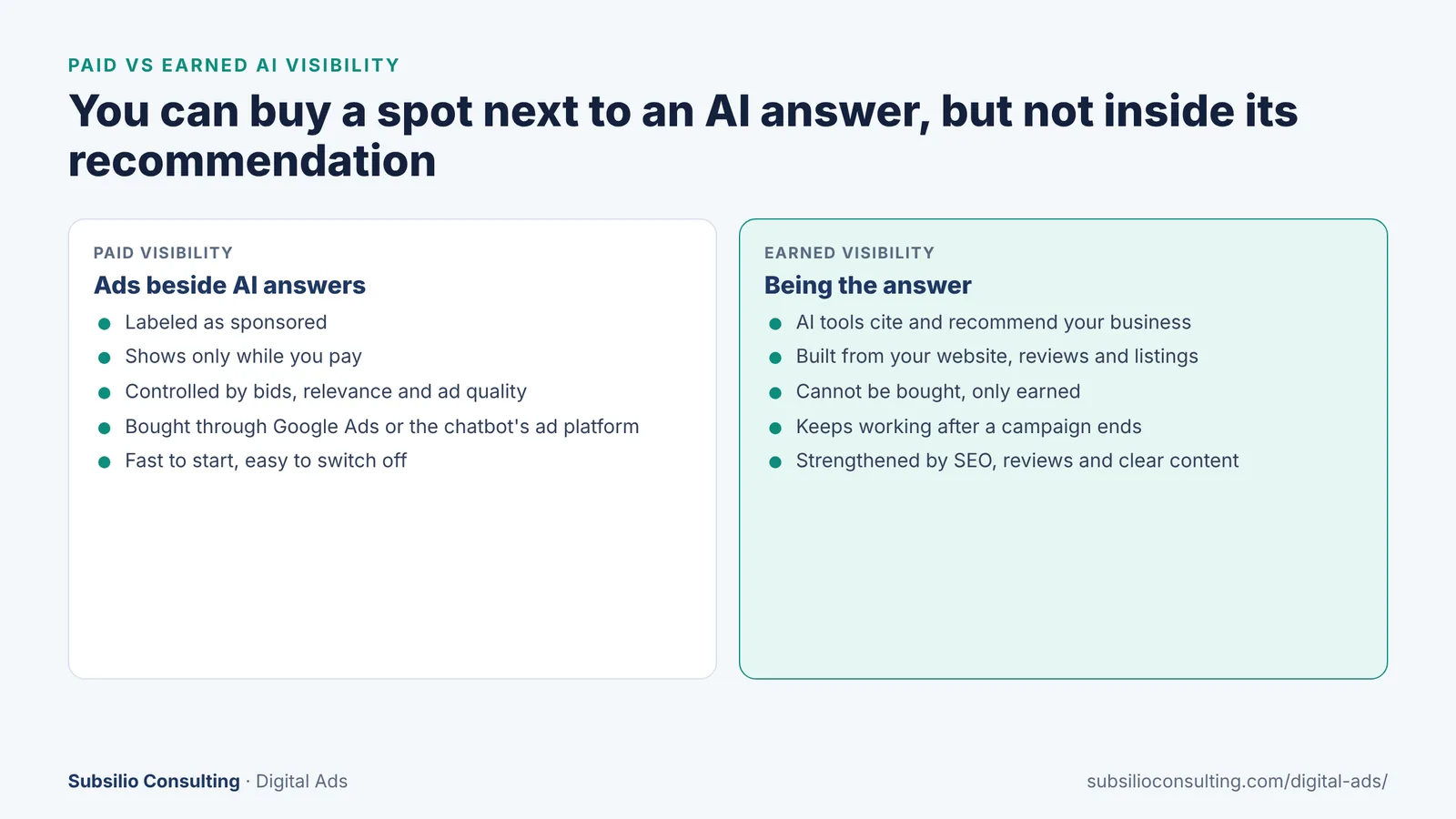
Paid placements sit beside AI answers. Recommendations inside the answer are earned.
Here is the most important thing to understand about AI search advertising: an ad next to an AI answer is not the same as being recommended in it. Both Google and OpenAI separate ads from the answer itself. ChatGPT states that advertisers cannot influence responses, and Google labels ads as sponsored.
That means two businesses can have very different outcomes in the same AI search:
- Business A pays for an ad that appears below the answer.
- Business B is named in the answer as a well-reviewed, trusted option.
Business B didn’t pay for that mention. It earned it through clear website content, consistent business listings, strong reviews and helpful information that AI systems can find and trust. Our guide on how AI assistants decide which local business to recommend explains those signals in detail, and why reputation matters more in AI search covers the role reviews play.
The smartest approach uses both: paid ads to guarantee visibility for high-value searches, and organic work to earn the recommendation.
Should Small Businesses Advertise in AI Search Right Now?
For Google AI Overviews and AI Mode: you may already be
If you run Google Search, Shopping or Performance Max campaigns, your ads may already be appearing around AI Overviews. There is nothing separate to sign up for. The question is not “should I buy AI ads,” but “are my existing campaigns set up to do well in AI-driven search?”
Google’s own recommendations for AI Overviews point to AI-powered targeting such as broad match and keywordless options (including AI Max for Search), plus smart bidding. For small businesses, that comes with a caution: broader matching needs strong conversion tracking and regular search term reviews, or it can spend money on poorly matched searches.
For ChatGPT ads: test carefully, if at all
ChatGPT advertising is new, and the rules, formats and availability are still changing. Before testing it, ask:
- Is Ads Manager available in your country, and does your business category qualify?
- Do your customers use ChatGPT to research what you sell? Product and comparison questions are a more natural fit than urgent local services.
- Can you track results reliably from click to lead or sale?
- Do you already have Google Ads and organic search working well? For most small businesses, those still come first.
Our honest view: for most local service businesses, the bigger near-term opportunity in AI search is earning recommendations organically. ChatGPT ads are worth watching and, for some businesses, worth a small, well-tracked test.
How to Prepare Your Google Ads for AI Search
- Get conversion tracking right. AI-driven bidding and broad matching learn from your conversions. If calls and forms aren’t tracked accurately, automation optimizes for the wrong things. Google’s guide to conversion measurement is the starting point.
- Write ads for conversational, specific searches. AI search queries tend to be longer and more detailed. Make sure your ad copy and landing pages answer specific questions, not just generic service names.
- Keep your landing pages detailed and helpful. AI-driven systems look at your landing page to understand what you offer. Thin pages give them little to work with.
- Use broader matching with guardrails. If you test broad match or AI Max, add strong negative keywords and review the search terms report regularly.
- Keep Shopping feeds clean (for e-commerce). Google recommends keeping product feeds current with quality images and videos.
- Watch overall results, not placement reports. Because AI Overview placements are reported with top ads, judge performance by leads, sales and cost per result.
How to Get Recommended in AI Answers Without Paying
Paid placements have limits. Here is what drives the organic side, where your business is mentioned inside the answer:
- Clear, structured content that answers real customer questions. Our guide to answer engine optimization explains how.
- Strong, recent reviews across the platforms your customers use. See our reputation marketing services.
- Consistent business information across your website, Google Business Profile and directories.
- Schema markup that helps search engines understand your business. See our structured data guide.
- Topical depth, so your site is seen as a reliable source. Our overview of generative engine optimization (GEO) covers this.
If you want a quick view of where you stand, our free Business Snapshot and AI checklist reviews your online presence and listings.
What This Means for Your Marketing Budget
You don’t need to rebuild your budget around AI search, but you should rebalance your attention:
- Keep funding Google Search ads for high-intent searches. AI placements are part of what those campaigns now reach.
- Invest in the organic signals (content, reviews, listings) that make AI tools recommend you. These keep working after a campaign ends.
- Treat ChatGPT ads as a test, not a core channel, until availability, formats and measurement mature for your industry.
- Measure by outcome. Leads, booked jobs and sales tell you more than impressions or placement labels.
Conclusion: Pay for Placement, Earn the Recommendation
AI search is not replacing advertising, but it is changing where ads appear and what they can and can’t do. Google already places ads around and within AI Overviews through campaigns many businesses are running today. ChatGPT has opened a new, clearly labeled ad space for people on its free and lower-cost plans.
What hasn’t changed is that nobody can buy their way into the answer itself. The businesses that win in AI search will combine well-run paid campaigns with the reputation, content and listings that make AI systems trust and recommend them.
If you want help preparing your ads and your online presence for AI search, our team works on both sides: digital ads and SEO and AI visibility. Book a free consultation and we’ll show you where your business stands today.
Want to Show Up in AI Search?
We help local businesses get seen in AI answers, paid and earned, without wasting budget on placements you cannot control.
Frequently Asked Questions About Ads in AI Search
Q1. Can small businesses advertise on ChatGPT?
Yes, in countries where OpenAI’s Ads Manager is available, businesses can sign up to advertise in ChatGPT. Ads appear below responses for users on the Free and Go plans and are labeled as sponsored. Some categories, such as political advertising, are not allowed, and ads don’t appear near sensitive topics like personal health.
Q2. Do ads in ChatGPT change the answers?
No. According to OpenAI, ads run on systems separate from the chat model and advertisers cannot shape or change ChatGPT’s responses. Ads appear after the answer and are clearly labeled as sponsored. Being recommended inside the answer cannot be bought.
Q3. How do ads show up in Google AI Overviews?
Google can show ads above or below AI Overviews, and within them in eligible markets and languages. These ads come from existing Search, Shopping and Performance Max campaigns. Advertisers cannot directly target or opt out of AI Overview placements, and Google reports them as top ads.
Q4. Do I need a separate budget for Google AI Overview ads?
No. There is no separate AI Overviews ad product to buy. If you already run eligible Google Ads campaigns, your ads may appear around AI Overviews. Focus on accurate conversion tracking, relevant ads and helpful landing pages so your existing campaigns perform well in AI-driven search.
Q5. Can I see how my ads perform in AI Overviews?
Not separately at the moment. Google says it does not currently offer segmented reporting for ads within AI Overviews and reports them as top ads. Judge performance by overall leads, sales and cost per result rather than placement data.
Q6. Are healthcare businesses eligible for ads in AI Overviews?
Google does not show ads within AI Overviews for sensitive verticals, including healthcare. Healthcare ads may still appear in other placements. ChatGPT also avoids showing ads near personal health conversations. Check each platform’s policies for your specific services.
Q7. Is it better to pay for AI ads or work on AI SEO?
For most local businesses, both matter, but organic AI visibility is the bigger long-term opportunity because recommendations inside AI answers can’t be bought. Use paid search ads to capture high-intent searches now, and invest in content, reviews and listings to earn recommendations that keep working over time.
Q8. How do I get my business recommended by ChatGPT or Google AI?
Publish clear, helpful content that answers customer questions, keep your business information consistent across your website and listings, earn steady positive reviews and use schema markup. AI tools draw on these signals when deciding which businesses to mention and trust.