
DIGITAL ADS
PPC Management Pricing: What Agencies Charge and What You Should Get for It
Ad spend, management fees and add-ons are three separate costs. What agencies charge, and what you should get for it.
ESTIMATED READ TIME: 11 MINUTES
Want an outside read on whether your ads are earning their keep?
Pay-per-click (PPC) advertising has two costs, and many business owners only think about one. The first is ad spend: what Google, Meta or LinkedIn charges you for clicks and impressions. The second is management: what you pay someone, or the time you spend yourself, to plan, build, test and improve the campaigns.
Management fees vary widely, and so does what you get for them. Two agencies can quote similar fees and deliver completely different levels of work. One might log in once a month and send a template report. Another might review search terms weekly, test new ads, fix tracking and build landing pages.
As an agency, we have obvious skin in this game, so this guide aims to be straight with you. It explains the common PPC pricing models, what should be included, the costs beyond ad spend, the protections Google requires agencies to give you, the red flags to watch for and the questions to ask before you sign.
Key takeaways
- PPC costs have two parts: ad spend paid to the platform, and the management fee paid to whoever runs your campaigns.
- The four common pricing models are flat retainers, percentage of ad spend, performance-based fees and hourly or project pricing.
- Compare what’s included, not just the fee.
- Strategy, search term reviews, testing, tracking and reporting are where results come from.
- Google’s policies require third parties to disclose management fees and report the exact amount Google charged, separate from their fees.
- You should own your ad account and have admin access, even if an agency manages it.
What You Are Actually Paying For
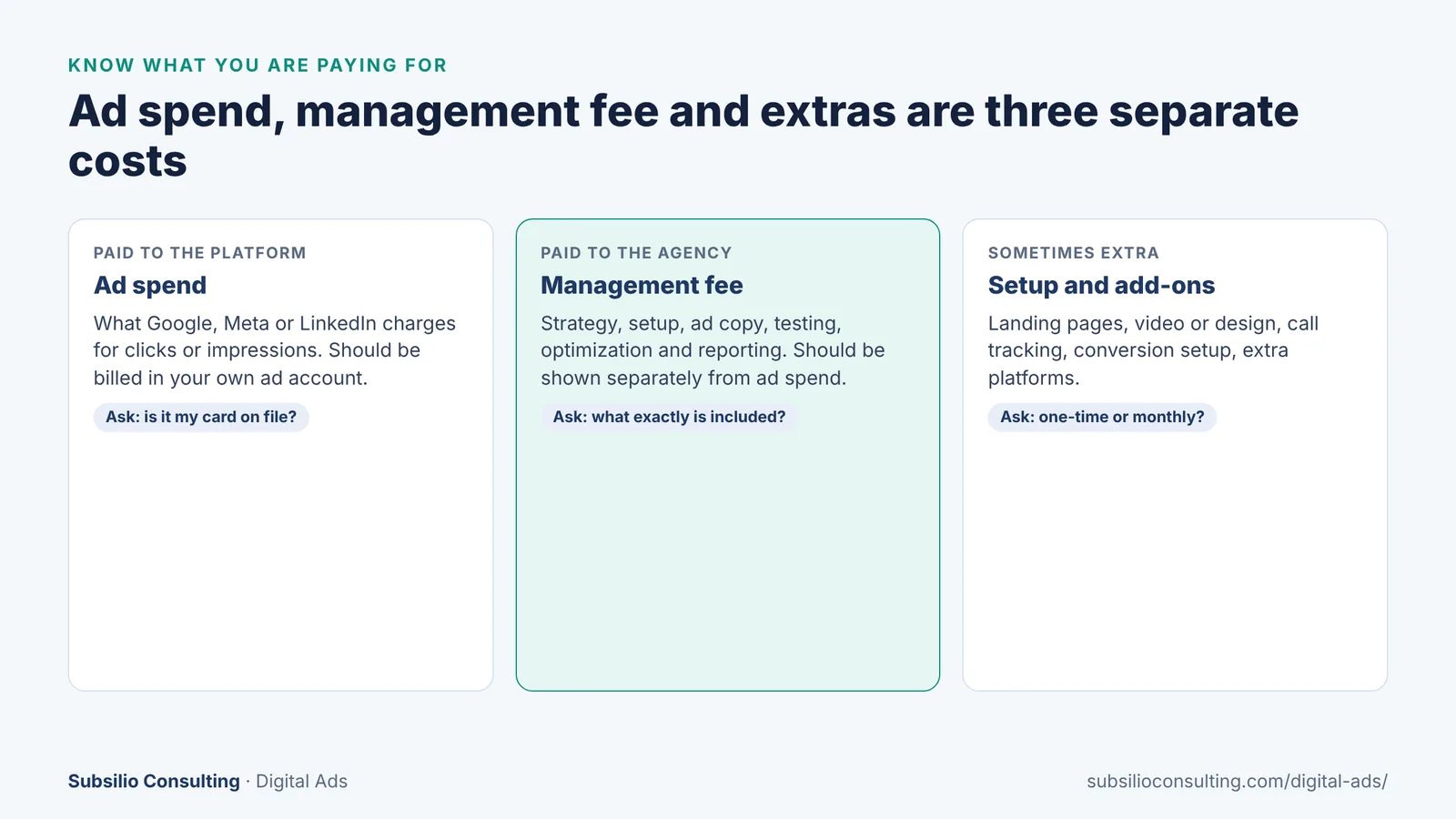
Ad spend, management fees and add-ons are separate costs and should be shown separately.
Ad spend
This is the money that goes to the advertising platform. It is set by your budget and the auction. Ideally, ad spend is billed directly to your own payment method inside your own ad account, so you can see exactly what the platform charged.
Management fee
This pays for the expertise and time to run your campaigns well. Good PPC management is ongoing work, not a one-time setup. It typically includes:
- Strategy: goals, budget allocation, channel choices and targeting.
- Account structure: campaigns, ad groups and keywords organized around your services.
- Keyword research and negative keyword management.
- Ad copy writing and testing.
- Bid strategy and budget management.
- Conversion tracking setup and maintenance.
- Regular search term and placement reviews.
- Reporting and calls to explain results and next steps.
Setup and add-ons
Some work is often priced separately:
- A one-time account setup or rebuild.
- Landing page design and development.
- Call tracking.
- Video, graphic design or photography for ads.
- Additional platforms (for example, adding Meta or LinkedIn to a Google Ads program).
The Four Common PPC Management Pricing Models
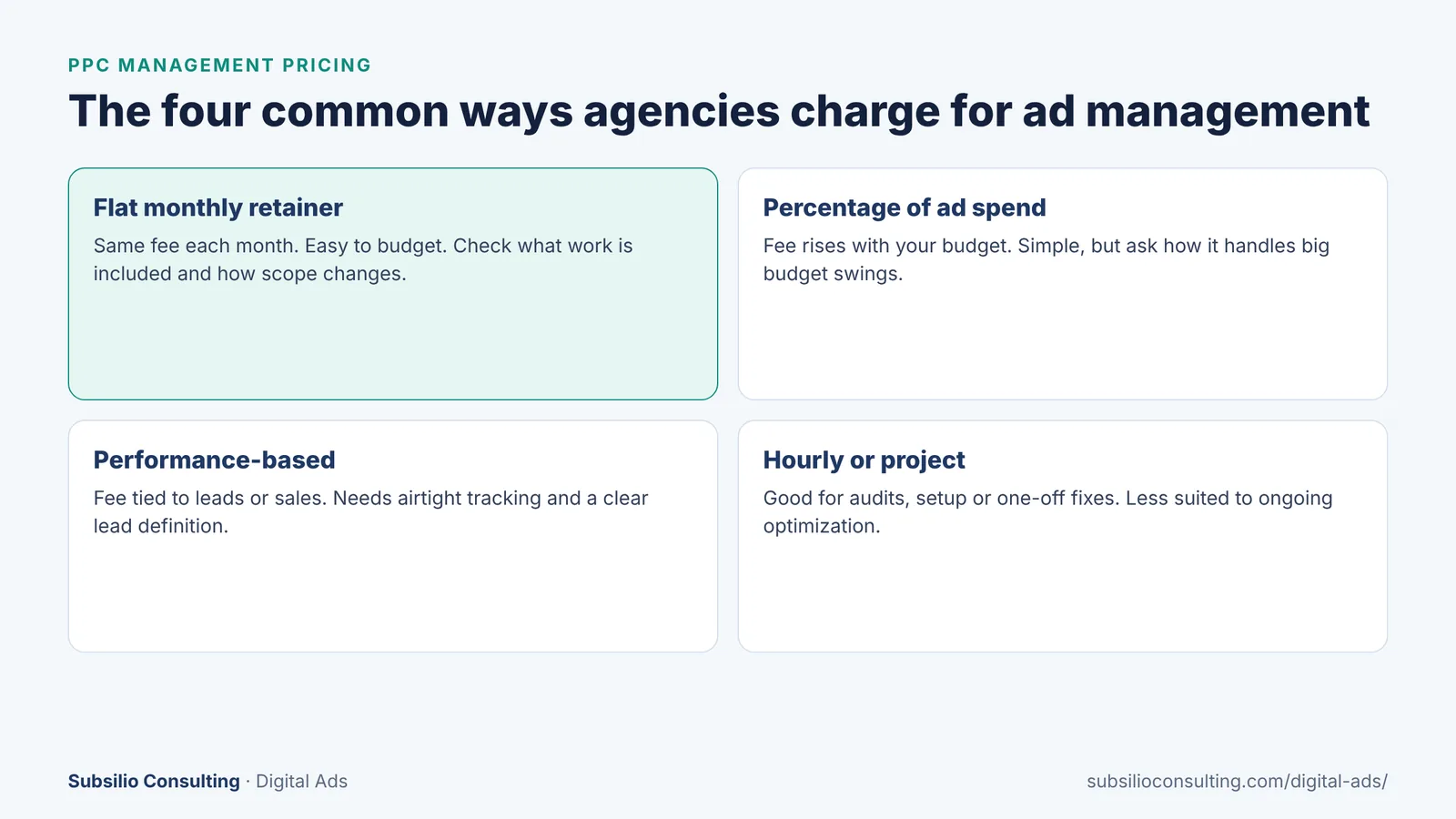
The four most common ways agencies price PPC management.
1. Flat monthly retainer
You pay the same fee each month for an agreed scope of work.
- Pros: predictable; the fee doesn’t rise just because your ad budget grows, so there’s no incentive to push you to spend more.
- Cons: the scope needs to be clear. If you add campaigns, platforms or locations, the fee may change.
- Best for: most small and mid-sized businesses with steady budgets.
2. Percentage of ad spend
The fee is a set percentage of what you spend on ads, often with a monthly minimum.
- Pros: simple; scales with the size of the account, which roughly tracks the work involved.
- Cons: the agency earns more when you spend more, so make sure budget recommendations are tied to results. Large budget swings can make fees unpredictable.
- Best for: larger or fast-growing accounts.
3. Performance-based pricing
The fee is tied to results, such as a fee per lead or a share of revenue.
- Pros: aligns the agency with outcomes you care about.
- Cons: needs airtight tracking and a clear, shared definition of a “lead” or “sale.” Disputes about lead quality are common. Agencies may focus on easy, low-quality leads.
- Best for: businesses with reliable tracking and a clear, consistent sales process.
4. Hourly or project pricing
You pay for time or for a defined project.
- Pros: good for audits, account setup, tracking fixes or training your in-house team.
- Cons: less suited to ongoing optimization, which is where most PPC gains come from.
- Best for: one-off audits, setups and consulting.
Hybrid models
Many agencies combine models, such as a base retainer plus a smaller percentage above a certain spend level, or a setup fee followed by a monthly retainer. Hybrids are fine if the terms are clear.
Comparing models side by side
To compare quotes fairly, calculate the total cost at the ad budget you actually plan to spend.
Hypothetical example: at a planned ad spend of $4,000 a month, a flat retainer of $800 costs $800. A 15% of ad spend model costs $600 at that budget, but $900 if your budget grows to $6,000. A performance model at $40 per qualified lead costs $800 for 20 leads. The cheapest option depends on your budget, your growth plans and how reliably leads can be tracked.
| Model | Predictability | Incentive alignment | Watch out for |
|---|---|---|---|
| Flat retainer | High | Neutral on spend | Unclear scope, slow response when needs change |
| % of ad spend | Medium | Rises with spend | Recommendations to spend more without results |
| Performance-based | Low | Tied to results | Lead quality disputes, tracking gaps |
| Hourly or project | Medium | Tied to time | Not built for ongoing optimization |
What Drives the Price of PPC Management?
- Number of platforms: Google only, or Google plus Meta, LinkedIn and others.
- Account size and complexity: number of services, locations, products and campaigns.
- Ad budget: larger budgets usually need more testing and closer monitoring.
- Scope of work: whether landing pages, creative, call tracking and CRM integration are included.
- Reporting and meeting cadence: monthly reports, weekly check-ins or live dashboards.
- Industry rules: regulated industries such as healthcare, finance and legal take extra care.
- Experience: specialists with a track record in your industry often cost more but waste less.
For a wider view of agency costs, read our Denver digital marketing agency price guide.
What Google Requires Agencies to Tell You
Google holds agencies and other third parties to specific rules, which protect you as the advertiser. Google’s third-party policy says third parties should be honest and transparent about their company, services, costs and expected results, and should not make false or unrealistic claims.
Google’s transparency requirements go further:
- Management fees must be disclosed. If a third party charges a fee separate from Google Ads costs, it must tell customers clearly, including in writing before the first purchase and on invoices.
- Reports must show real Google costs. If monthly performance reports are part of the agreement, they must include costs, clicks and impressions, and report the exact amount Google charged, excluding the agency’s fees.
- You can get your account ID. Third parties must provide customers with their Google Ads customer IDs when asked.
These rules matter. If an agency can’t or won’t show you what Google charged, separate from their fee, treat that as a serious warning sign.
Who Should Own Your Ad Account?
You should. Even if an agency builds and runs your campaigns, the ad account, its data and its history should belong to your business. Google offers several access levels, and only Admin access can give or remove access for other users and manage account links.
Make sure:
- The account is set up in your business’s name, with your billing details.
- You have Admin access, and the agency has the access it needs.
- Your conversion tracking, analytics and tag manager accounts are also in your name.
- If you part ways, you keep your account, data and campaign history.
Should You Hire a PPC Agency or Do It Yourself?
Managing your own campaigns can work, especially with a small budget and a simple business. Hiring help makes more sense as complexity and budget grow.
| Option | Works best when | Main risk |
|---|---|---|
| Do it yourself | Small budget, simple services, you have time and interest to learn | Mistakes that quietly waste budget for months |
| Freelancer | Single platform, modest budget, clear goals | Limited capacity and coverage |
| In-house hire | Large, steady budgets across several platforms | Salary and training cost; one person’s knowledge |
| Agency | You want a team, several platforms, tracking and landing pages handled | Paying for a team you don’t actually get |
The question is not “Can I afford an agency?” but “What does it cost me in wasted spend and missed leads if the account isn’t managed well?” Our guide on DIY marketing vs hiring a Denver digital agency walks through this decision in more detail.
Red Flags When Choosing a PPC Agency
- They won’t show ad spend and management fees separately.
- The ad account is set up in their name, or they won’t give you admin access.
- Reports show impressions and clicks, but not leads, calls or sales.
- They guarantee a specific ranking or result.
- There is no conversion tracking, or they can’t explain how it works.
- They don’t review search terms or add negative keywords.
- Long contracts with steep cancellation fees and no performance reviews.
- You can’t reach a real person who knows your account.
Questions to Ask Before You Sign
- What exactly is included in the monthly fee? What costs extra?
- Who owns the ad account and the data if we stop working together?
- How will you track calls, forms and sales?
- How often do you review search terms and adjust campaigns?
- What will monthly reports include, and will they show the exact platform costs?
- Who will actually manage my account, and how often will we talk?
- What results are realistic in the first three months, and how will we measure them?
- What is the contract length and cancellation policy?
- Do you have experience with businesses like mine? Can I speak to a client or read reviews?
Before signing with any agency, read their reviews. You can see what our clients say on our reviews page, and our guide on how to choose the right digital marketing agency in Denver offers a broader checklist.
Conclusion: Judge the Work, Not Just the Fee
PPC management pricing is less about the size of the fee and more about what it buys. A low fee for a hands-off account can cost far more in wasted ad spend than a fair fee for active, accountable management. The right agency is transparent about costs, gives you ownership of your account, tracks real leads and sales, and keeps improving your campaigns month after month.
Use the pricing models, red flags and questions in this guide to compare options on equal terms. Ask every agency, including us, to put the scope, fees and reporting in writing.
At Subsilio, we keep ad spend in your account, show our fees separately and report on the leads and results that matter to your business. See how we manage digital ads, learn more about our team or book a transparent pricing call.
Want Pricing You Can Actually Understand?
We will walk you through what management covers, what it costs and who owns your ad account. No surprises.
Frequently Asked Questions About PPC Management Pricing
Q1. How much does PPC management cost?
PPC management costs depend on the pricing model, number of platforms, account complexity, ad budget and scope of work. Common models are flat monthly retainers, a percentage of ad spend, performance-based fees and hourly or project pricing. Compare quotes based on total cost at your planned ad spend and what work is included.
Q2. Is the management fee included in my ad spend?
It shouldn’t be blended. Ad spend is what the platform charges for your ads, and the management fee is what you pay for someone to run them. Google’s policies require third parties to disclose management fees and to report the exact amount Google charged, separate from their fees.
Q3. What is a fair percentage of ad spend for PPC management?
There is no single fair percentage, because it depends on budget size, complexity and scope. Many agencies charge a percentage with a monthly minimum. Compare the total cost against flat-fee quotes at your budget, and make sure recommendations to increase spend are tied to results.
Q4. Should I own my Google Ads account?
Yes. Your business should own the Google Ads account, with your billing details and Admin access, even when an agency manages it. That protects your data, campaign history and conversion tracking if you change agencies.
Q5. Is it worth hiring a PPC agency?
It is often worth it when your budget, number of platforms or account complexity grows beyond what you have time to manage well. A good agency can lower wasted spend and improve lead quality. For very small budgets and simple businesses, managing ads yourself or using an audit-and-training approach may make more sense.
Q6. What should a PPC management fee include?
A PPC management fee should include strategy, campaign structure, keyword and negative keyword management, ad writing and testing, bid and budget management, conversion tracking upkeep, regular search term reviews and clear reporting. Landing pages, creative and call tracking may be included or billed separately.
Q7. What questions should I ask a PPC agency?
Ask what the fee includes, who owns the account, how leads and sales are tracked, how often campaigns are reviewed, what reports include, who manages your account, what results to expect, the contract terms and whether they have experience in your industry.
Q8. Are performance-based PPC agencies better?
Not always. Performance pricing aligns fees with results, but only works with reliable tracking and a clear definition of a qualified lead. Without those, disputes and low-quality leads are common. A transparent retainer with clear reporting is often simpler for small businesses.