
REPUTATION MARKETING
How to Ask Customers for Reviews: Scripts, Timing, and Templates That Work
The complete playbook: when to ask, what to say, copy-paste scripts for every channel, and the compliance lines you cannot cross.
ESTIMATED READ TIME: 11 MINUTES
Want the whole review engine built and run for you? Skip ahead and talk to our team.
Here is the uncomfortable math of online reviews: nearly every potential customer reads them, most happy customers are willing to write one, and most businesses still never ask. Independent consumer research consistently finds that around 97 percent of consumers read reviews when evaluating a local business, and that a clear majority will leave one when asked. The gap between those two numbers is the cheapest marketing opportunity your business has. Not ads. Not a redesign. A well-timed, well-worded ask.
At Subsilio Consulting, review generation is the foundation of every reputation marketing program we run, and after years of building these systems for service businesses, we can tell you the difference between a trickle of reviews and a steady stream is rarely the quality of the business. It is whether the ask happens at the right moment, through the right channel, with a direct link, and with one polite follow-up. That is it. That is the whole system.
This guide gives you all of it: the timing rules by business type, copy-paste scripts for in-person, SMS, email, and phone, the follow-up cadence, the compliance lines that can get your reviews deleted (or get you fined), and how to scale the process without turning it into spam.
The system in one paragraph
Ask every customer (no filtering), at the moment of peak satisfaction, through the channel they already use with you, with a message under 75 words containing exactly one direct link to your Google review page. Then send one polite reminder 3 to 5 days later and stop. Never offer incentives, never pre-screen for happy customers, and respond to every review you receive.
Why Asking for Reviews Is Worth Systemizing
If you need to convince yourself, or a business partner, that this deserves a real process, here is the case:
Consumers overwhelmingly check reviews before choosing a local business, and star ratings act as a hard filter: many people will not consider a business below roughly a 3-to-4-star threshold at all.
Review volume, velocity, and ratings influence where you appear in Google’s local results. A dormant review profile quietly undermines everything you invest in SEO and Google Business Profile optimization.
AI-generated summaries now sit at the top of many local search experiences, synthesizing what your reviews say about you. Recent, specific, plentiful reviews give those systems good raw material; a thin profile gives them nothing, or worse, lets three old complaints define you. We have covered how reviews now shape AI search results in detail.
You cannot remove most negative reviews, but you can make any single review statistically irrelevant.
Every five-star review can become website social proof, ad copy, and social content: the heart of leveraging user-generated content.
Before You Ask: The Rules That Actually Have Teeth
This section comes before the scripts on purpose. Review solicitation is now regulated territory, and several tactics that were standard advice a few years ago are today explicit violations of Google’s review policies and, in the US, of the FTC’s Rule on the Use of Consumer Reviews and Testimonials, which carries civil penalties that can exceed $50,000 per violation. Here is what is off the table:
| Prohibited practice | Why it is banned |
|---|---|
| Incentivized reviews discounts, gifts, loyalty points, contest entries, or payment for a review (or for removing or revising one) | Violates Google policy and the FTC rule. Applies even if you do not require the review to be positive. |
| Review gating surveying customers first and only sending review links to the happy ones | Google prohibits selectively soliciting positive reviews; the FTC treats suppressing the negative side as misrepresenting your reputation. |
| On-premises pressure review kiosks, shared tablets at checkout, or asking customers to post before they leave | Explicitly banned in Google’s updated policies; also creates same-IP review clusters that trip spam filters. |
| Requesting specific content asking customers to mention keywords, or a staff member’s name | Now explicitly against Google policy; scripted-sounding reviews are also easy for filters (and humans) to spot. |
| Staff review quotas and insider reviews employees, family, or friends posting reviews | Conflict-of-interest content; commonly removed, and it can draw scrutiny to the whole profile. |
| Buying reviews from vendors, exchanges, or fake accounts | Illegal under the FTC rule, aggressively detected by Google, and grounds for profile restrictions or public warning labels. |
The good news: everything in the rest of this guide is fully compliant. Asking for reviews is completely allowed. Google encourages it. What is banned is filtering, incentivizing, and pressuring. Ask everyone, honestly, and you have nothing to worry about.
Timing: The Variable That Doubles (or Kills) Your Response Rate
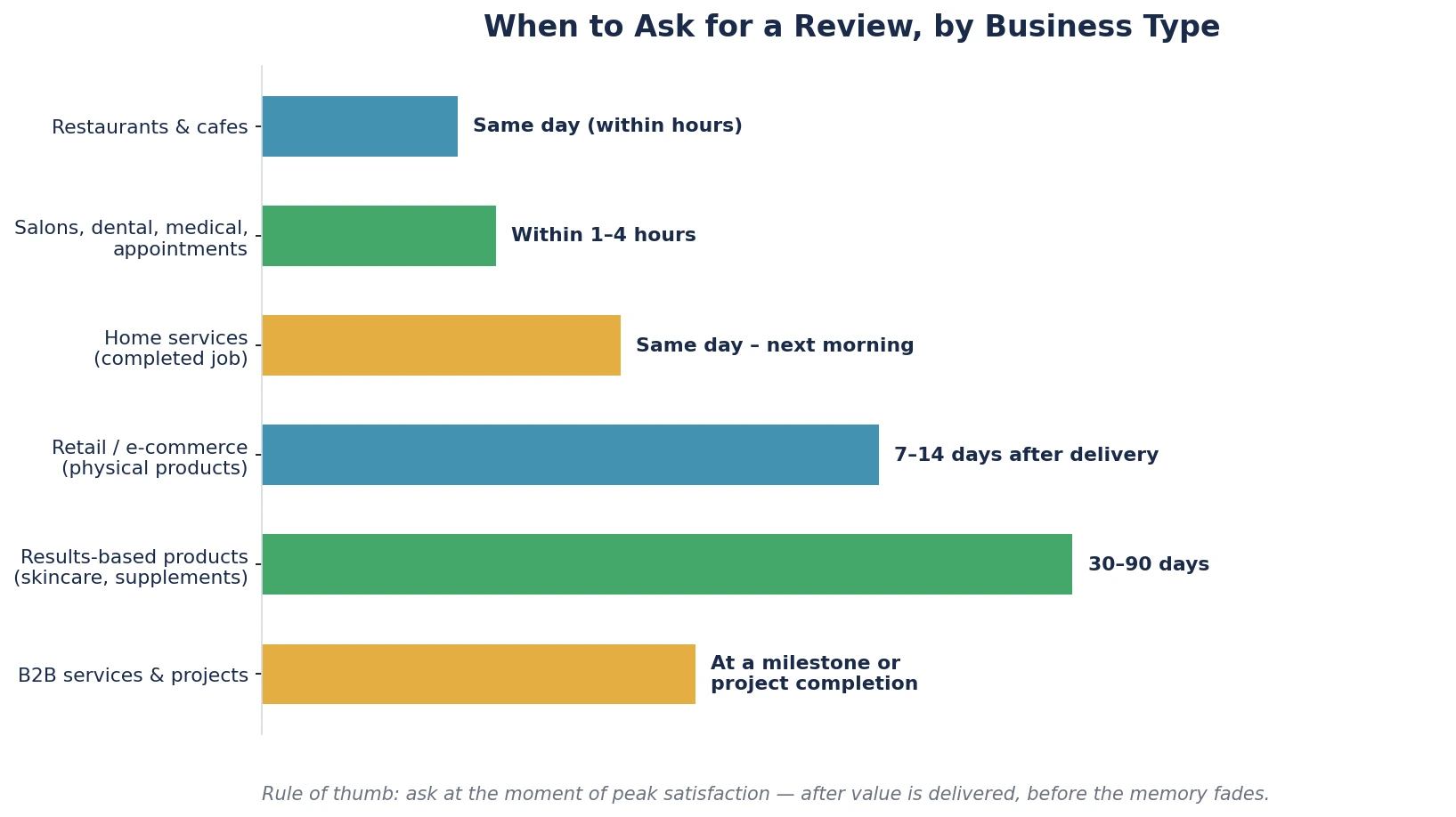
Ask too early and the customer has nothing to say. Ask too late and the emotional peak is gone, and reviews are written on emotion. The universal principle: ask at the moment of peak satisfaction, after the value has been fully delivered. What that moment looks like depends on your business:
Same day, ideally within one to four hours of the visit, while the experience is vivid.
At the final walkthrough or the same evening. The moment the customer is standing in their finished kitchen is the moment.
Wait 7 to 14 days after delivery so the customer has actually used the product.
30 to 90 days, once results are visible. An early ask here produces vague, low-value reviews.
At milestone wins and at project completion, not at invoice time. Never attach the ask to the bill.
Beyond the calendar, watch for signal moments: a customer compliments you unprompted, tags you on social media, refers a friend, or renews. Someone actively expressing happiness is pre-qualified; ask right then. As for clock time: mid-week tends to outperform weekends for email, and daytime-to-early-evening works best for SMS. But do not overthink the hour; the proximity to the positive experience matters far more than the day of the week.
First, Get Your Direct Google Review Link (Two Minutes)
Every script below depends on one thing: a link that opens the review box in one tap. Making customers search for your business and find the review button themselves will cost you most of your responses.
To get your link: sign in to your Google Business Profile, find the “Ask for reviews” (or “Get more reviews”) option, and copy the short share link. It typically looks like g.page/r/… and it opens the review box directly. Use that exact link everywhere: texts, emails, invoices, and as the target of a QR code for printed materials. If you operate multiple locations, generate and label a link for each one.
The Anatomy of a Review Request That Gets Answered
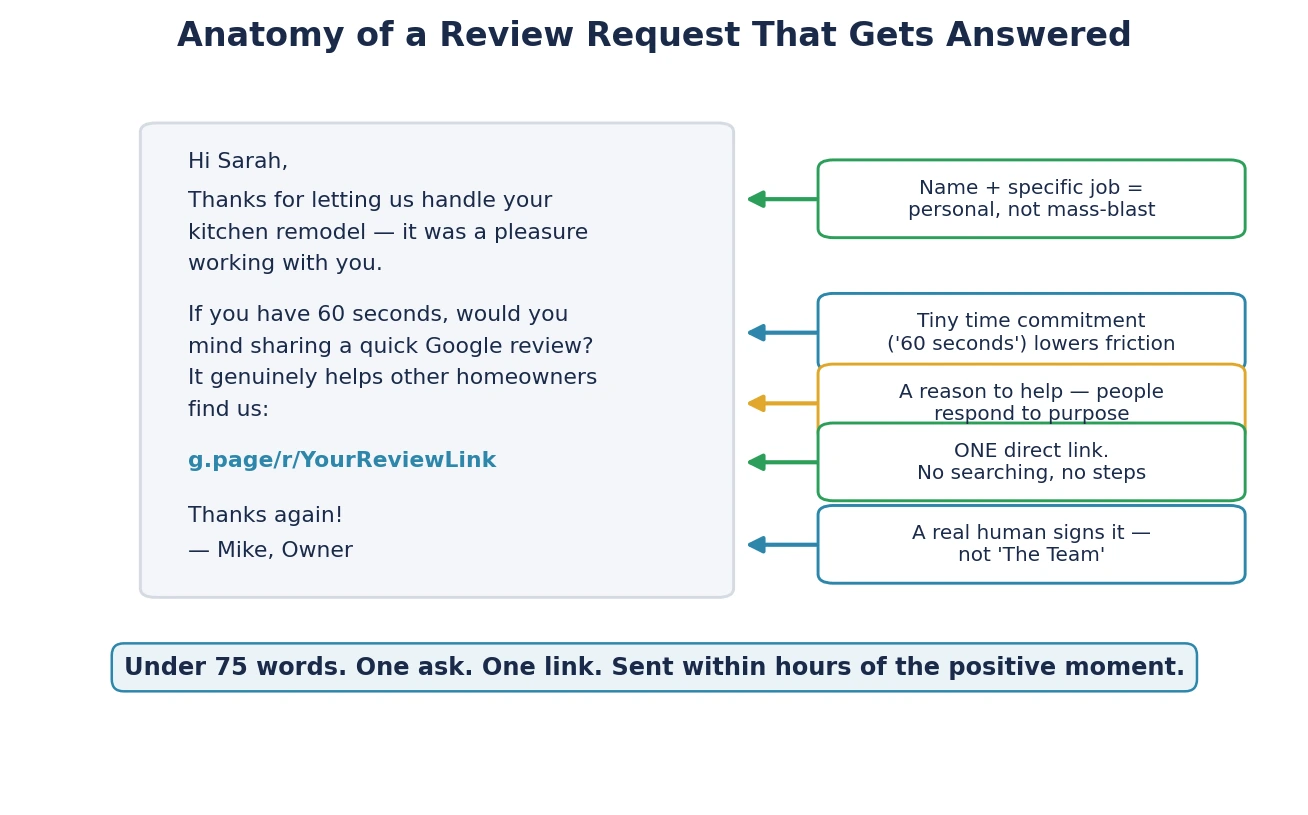
Across the thousands of requests our client systems send, the messages that convert share five traits, and the messages that flop always miss at least two of them:
The customer’s name and the actual service. “Thanks for letting us handle your kitchen remodel” beats “Dear valued customer” every single time.
“Would you mind leaving a quick review? It takes about 60 seconds” is a clear question with a tiny time cost. “We value your feedback” is not an ask.
People respond to purpose: “Reviews genuinely help other homeowners find us” or “As a small business, every review makes a real difference.”
One link, zero instructions, zero extra choices. Every added step loses people.
Signed by a real person: the owner, the technician, the stylist. Not “The Team.”
Choosing Your Channels (Use Two, in Sequence)
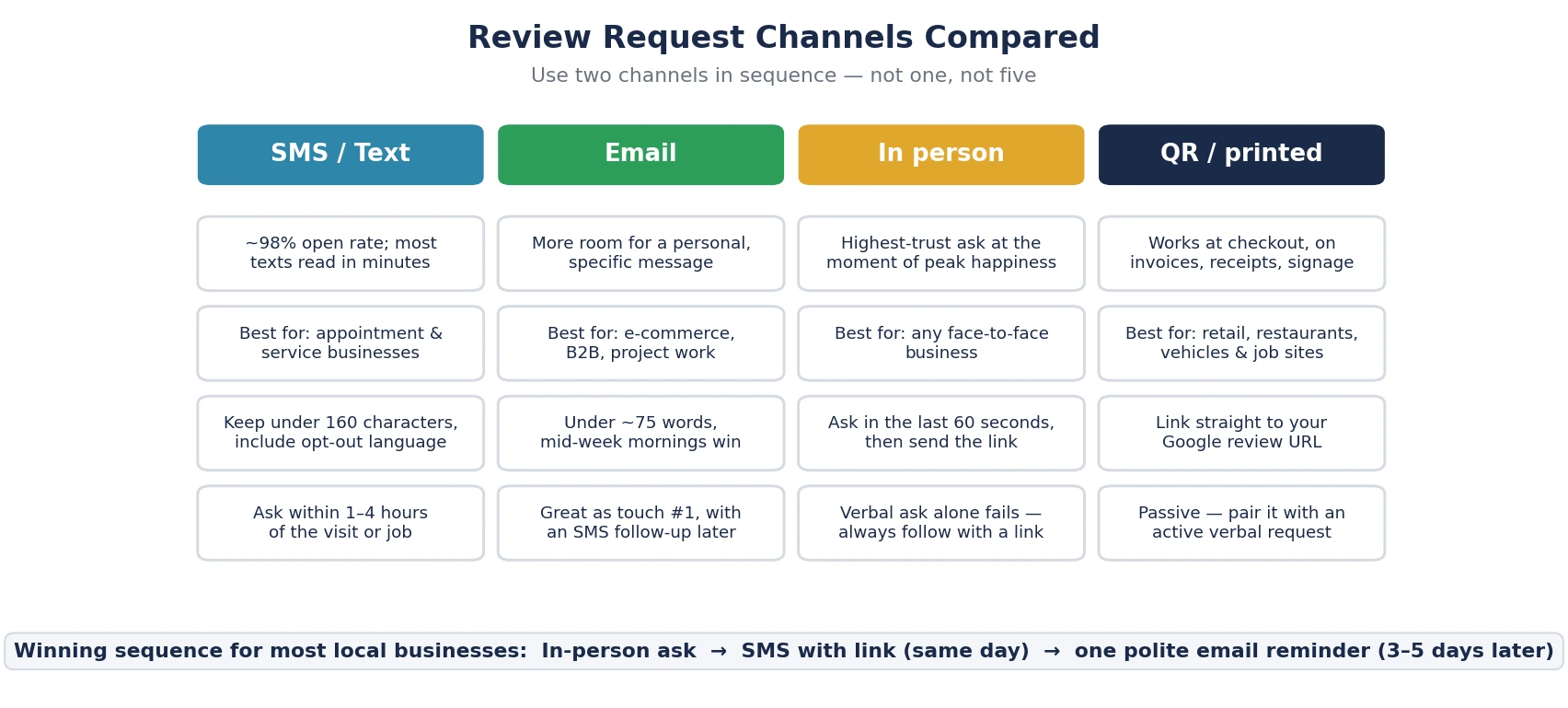
Each channel has a distinct job. SMS gets seen: texts have near-universal open rates and are typically read within minutes. Email gives you room for specificity and works as a professional first touch for B2B and e-commerce. In-person asks carry the most trust but evaporate without a written follow-up. QR codes and printed links capture passive moments at the counter, on invoices, and on job-site signage.
For most local businesses, the winning sequence is: a brief in-person ask at the moment of peak satisfaction, an SMS with the link the same day, and one email reminder a few days later if nothing happens.
The Scripts and Templates (Copy, Personalize, Send)
Everything below is written to be compliant and conversion-tested in structure. Replace the bracketed placeholders, keep the length discipline, and resist the urge to add more words. Shorter converts, consistently.
In-person scripts (the 60-second window)
AFTER A COMPLETED SERVICE
“I’m really glad you’re happy with how the [job/service] turned out. Quick favor: reviews on Google make a huge difference for a business our size. I’ll text you a direct link so it’s one tap. Would that be okay?”
AT THE FRONT DESK / CHECKOUT
“Thanks so much for coming in, [Name]. If you enjoyed your visit, we’d love a quick Google review. There’s a link on your receipt, and it honestly helps us more than any ad we could run.”
WHEN A CUSTOMER COMPLIMENTS YOU UNPROMPTED
“That genuinely means a lot, thank you. Would you be willing to say that in a Google review? I can send you the link right now; it takes about a minute.”
The rule that makes in-person asks work: always pair the verbal ask with a link sent the same day. People forget within hours, no matter how sincere they were. And note the compliance line: invite them to review at their convenience; do not hand them a device or stand over them while they type.
SMS templates (under 160 characters)
SAME-DAY, POST-SERVICE
“Hi [Name], thanks for choosing [Business] today! If you have 60 seconds, a quick Google review would mean a lot: [link]”
POST-JOB (HOME SERVICES)
“Hi [Name], it was a pleasure working on your [project]. If you’re happy with the result, would you share a quick review? [link] – [First name], [Business]”
THE SINGLE FOLLOW-UP (3 TO 5 DAYS LATER)
“Hi [Name], just a gentle nudge: if you have a spare minute, we’d still love your feedback on your recent [service]: [link]. Thanks either way!”
APPOINTMENT BUSINESSES (SEND 1 TO 4 HOURS AFTER THE VISIT)
“Hi [Name], thanks for visiting [Business] today! We’d love to hear how it went. Quick review link: [link]”
If you are sending texts in bulk through a platform, include opt-out language (“Reply STOP to opt out”); it is required by carrier rules in the US. And only text customers who have given you their number in the course of doing business with you.
Email templates (under 75 words of body copy)
Phone script (great for B2B and older customer bases)
THE CHECK-IN CALL
“Hi [Name], this is [Your name] from [Business], just calling to make sure everything’s still working well with [service/product]. … That’s great to hear. While I have you: reviews on Google really help us, and yours would mean a lot. Can I text or email you the direct link so it’s easy?”
The phone ask converts because it is a conversation, not a broadcast. But it must still end with a link sent immediately after the call.
Passive touchpoints (set once, collect forever)
“Happy with our work? A 60-second Google review helps more than you know: [link / QR code]”
“Enjoyed working with us? Leave us a quick Google review → [link]”
“Love your experience? Scan to leave us a Google review. It takes a minute and means the world.” (QR pointing to your direct review link.) Signage inviting reviews is fine; pressuring customers to post before leaving, or providing an on-site device to do it, is not.
A small card with the QR code, handed over at the final walkthrough.
Rather have all of this running on autopilot?
We build compliant, automated review generation systems for businesses like yours: the timing, the sending, the monitoring, and the responses. Talk to us.
Follow-Up Cadence: One Reminder, Then Stop
A single well-timed reminder is one of the highest-leverage moves in review generation; practitioners consistently report that a polite second touch meaningfully lifts total response rates, often by half or more over a single ask. But the curve dies immediately after that.
The discipline: two touches maximum, spaced three to five days apart, then let it go permanently. A third ask does not produce reviews; it produces annoyance, unsubscribes, and occasionally the negative review you were trying to avoid. If a customer does not respond to two asks, the answer was no.
Scaling It: From Owner’s Memory to Automatic System
Everything above works manually for a handful of customers a week. Past that, the constraint is not the script, it is consistency, and consistency is a process problem. The businesses that build large review profiles all do the same four things:
Connect your booking system, POS, invoicing tool, or CRM so a completed job automatically queues the request at the right delay for your business type. No one has to remember.
Not just the ones you think loved you. This is both the compliant approach (no gating) and the smart one: your “quiet” customers are an untapped majority, and a natural mix of feedback reads as authentic to both humans and Google’s filters.
Every review, positive and negative, gets a specific, human reply within a day or two. Response quality is now part of how customers and AI summaries judge you; our guide to managing online reviews covers the frameworks.
Requests sent, reviews received, response rate by channel, and average rating trend. If response rates sag, the timing or the channel is usually the culprit, not the customer.
This is exactly the machinery we build and run for clients inside our reputation marketing service: automated, compliant review generation plus monitoring and response management, and then we put those reviews to work across your website, ads, and social channels.
The Seven Mistakes That Quietly Kill Review Programs
“Just find us on Google” loses the majority of willing reviewers.
A request two months after the job lands in an emotional vacuum.
Anything past roughly 75 words gets skimmed and abandoned.
Review gating violates platform policy and federal rules, and the pattern is detectable.
Even innocent-feeling ones (“leave a review for 10 percent off”) risk review removal and regulatory penalties.
Blasting your entire customer list in one afternoon creates a velocity spike that looks manipulated; a steady drip beats bursts.
An unanswered review section tells prospects (and AI systems) that nobody is home.
The Bottom Line: The Businesses With the Most Reviews Are Simply the Ones That Ask
There is no secret here, and that is the point. Your competitors with 400 reviews do not have better customers than you. They have a system: a direct link, a well-worded ask at the moment of peak satisfaction, one follow-up, and the discipline to run it on every single customer, every single week, without gating or gimmicks.
Start today with the two-minute step (grab your direct review link), pick the two scripts that fit your business, and send your first ten requests this week. The compounding starts immediately: in your star rating, your local rankings, and increasingly in what AI search tells people about you before they ever click.
Or Skip the Scripts and Have Us Run the Whole Machine
The asking, the timing, the monitoring, the responses, and the marketing of every five-star result: that is precisely what our reputation marketing service does. Get in touch for a straightforward look at your review profile and what we would build for it.
Frequently Asked Questions About Asking for Reviews
Q1. Is it legal to ask customers for Google reviews?
Yes, asking for reviews is completely legal and explicitly permitted by Google. What is prohibited is manipulating the outcome: offering incentives, pre-screening customers by satisfaction (review gating), pressuring customers to post on-premises, dictating what the review should say, or buying reviews. Ask everyone honestly and you are fully compliant.
Q2. Can I offer a discount or freebie in exchange for a review?
No. Incentivized reviews violate Google’s policies even when you do not require a positive rating, and in the US they can violate the FTC’s consumer review rule, which carries civil penalties per violation. This includes contest entries, loyalty points, and gift cards. The only compliant “reward” is a genuine thank-you.
Q3. What is review gating, and why does everyone say to avoid it?
Review gating is sending customers a satisfaction survey first, then routing only the happy ones to Google while steering unhappy ones to a private feedback form. It used to be a standard feature of review software; today it violates Google’s solicitation policies, and the FTC treats it as misrepresenting your true reputation. Send everyone the same review link. You can still run internal feedback surveys; just do not use them as the gate in front of the review ask.
Q4. What is the best time of day to send a review request?
Proximity to the experience matters more than the clock, but as tiebreakers: mid-week (Tuesday to Thursday) mornings perform best for email, and late morning through early evening works well for SMS. Avoid early mornings, late nights, and Sunday mornings. For service visits, sending a text within one to four hours of the appointment is the single most reliable pattern.
Q5. How many review requests should I send per customer?
Two, total: the initial ask and one polite reminder three to five days later. A well-timed single follow-up substantially lifts response rates; a third message mostly generates irritation. After two touches, stop permanently for that transaction.
Q6. Why did a customer’s review disappear after they posted it?
Google’s filters remove reviews that trip spam signals. Common triggers include reviews posted from your business’s Wi-Fi or location (which is why on-site posting backfires), brand-new reviewer accounts, several reviews arriving in a rapid burst, or wording that looks scripted. It usually is not personal, and it is another reason to collect reviews steadily, off-premises, from customers’ own devices.
Q7. Can my employees or family members leave us reviews to get started?
No. Reviews from employees, former employees, family, and friends are conflict-of-interest content under Google’s policies and are removed when detected, and a cluster of insider reviews can draw scrutiny to your whole profile. Your first ten reviews should come from real customers; the scripts in this guide will get you there faster than shortcuts will.
Q8. How do I ask for a review without sounding pushy or desperate?
Three ingredients remove the awkwardness: ask at a moment when the customer is already happy (so the request feels like a natural extension of the conversation), make the cost tiny and explicit (“about 60 seconds”), and give the honest reason (“it genuinely helps a business our size”). Then make it effortless with one direct link and give them a graceful out: “no pressure at all.” Confidence plus ease reads as professional, not needy.