SOCIAL ADS
How Much Do Facebook and Instagram Ads Cost? A Small Business Budget Guide
There is no fixed price for Meta ads. Here is what drives the cost, and how to set a budget that matches the leads you need.
ESTIMATED READ TIME: 11 MINUTES
Want an outside read on whether your ads are earning their keep?
“How much do Facebook ads cost?” is one of the first questions small business owners ask us, and one of the hardest to answer with a single number. Two businesses in the same city can run ads on the same day and pay very different amounts, because Meta (the company behind Facebook and Instagram) doesn’t sell ads at a fixed price. It runs an auction for every ad you see.
That is actually good news for small businesses. It means you can start with a modest budget, set your own limits and pay less when your ads are more relevant. But it also means you need to understand what drives cost, or you can spend a lot and learn very little.
This guide explains how Facebook and Instagram ad pricing works, the factors that push costs up or down, the difference between cost per click and cost per lead, and a simple way to set a monthly budget based on the results you need. It is written from what our team sees managing Meta ad campaigns for local businesses.
Key takeaways
- Facebook and Instagram ads are priced by auction, so there is no fixed cost.
- You set the budget, and Meta spends it competing for your chosen audience.
- Your cost is shaped by your audience, competition, ad quality, campaign objective, bid strategy and the season.
- Cost per click and cost per lead are different.
- A cheap click is worthless if your landing page or offer doesn’t convert.
- The best way to set a budget is backward: start from the customers you want, your close rate and your expected cost per lead.
- Budget for more than ad spend: creative, tracking and management also cost time or money.
How Facebook and Instagram Ad Pricing Works
When you create a campaign in Meta Ads Manager, you don’t buy a set number of ads at a set price. You tell Meta:
- Your objective: what you want people to do, such as visit your website, send a message, fill out a lead form or buy something.
- Your audience: who should see the ads, by location, age, interests or your own customer lists.
- Your budget: how much to spend per day or over the life of the campaign.
- Your bid strategy: whether Meta should get the most results for your budget or stay under a target cost.
Every time there is a chance to show an ad to someone in your audience, Meta runs an auction among all the advertisers trying to reach that person. Meta’s system weighs how much each advertiser is willing to pay, how likely the person is to take the action the advertiser wants, and the quality of the ad. The ad that offers the most value, to the advertiser and the person, wins.
Facebook and Instagram ads are placed through the same system, so you can run them together or choose specific placements. In most cases, letting Meta place ads across both gives the system more room to find cheaper results.
How you are charged
Depending on your settings, you may be charged per thousand impressions (CPM), per click (CPC) or, for some setups, per result. Most campaigns are charged on impressions, even when Meta optimizes for clicks or leads. That’s why your reports show several cost figures:
| Metric | What it means | What it tells you |
|---|---|---|
| CPM (cost per 1,000 impressions) | What you pay to show your ad 1,000 times | How competitive and expensive your audience is |
| CPC (cost per click) | Spend divided by link clicks | How appealing your ad is to the audience |
| CTR (click-through rate) | Share of people who click after seeing the ad | Whether your creative and offer grab attention |
| Cost per lead or result | Spend divided by leads, messages or purchases | The number that actually matters for your business |
| ROAS (return on ad spend) | Revenue divided by ad spend | Whether ads are profitable (for e-commerce) |
The Six Factors That Decide What You Pay
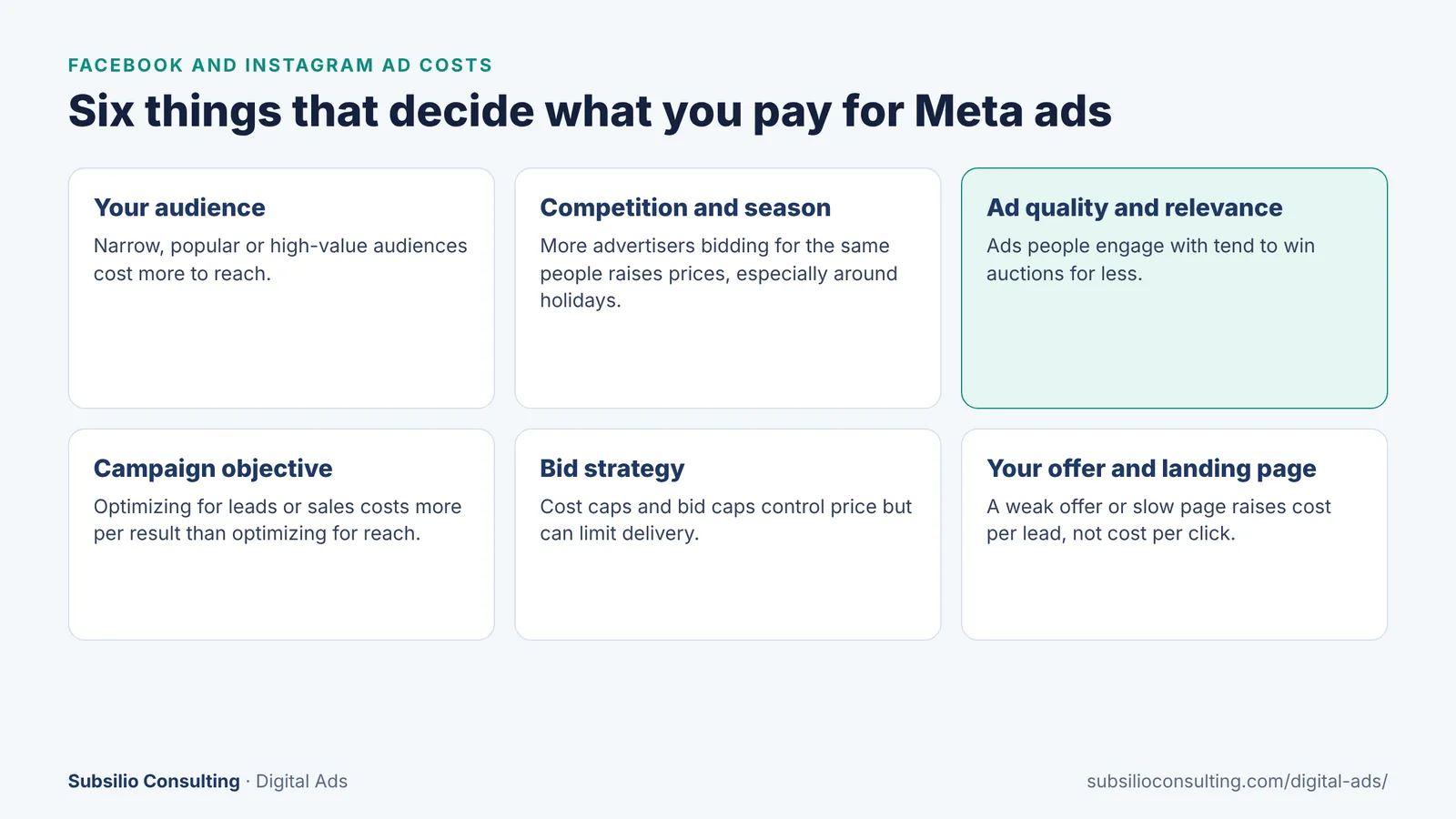
The main drivers of Facebook and Instagram ad costs.
1. Your audience
Some audiences are more expensive to reach than others. Audiences with high purchasing power, very narrow audiences and audiences that many advertisers want (such as homeowners or business decision-makers) usually cost more per impression. A very small audience can also limit how efficiently Meta can deliver your ads.
2. Competition and season
Because pricing is an auction, more advertisers means higher prices. Costs often rise during busy shopping periods such as the weeks around Black Friday and the end-of-year holidays, when retailers and large brands increase their budgets. Plan for this rather than being surprised by it.
3. Ad quality and relevance
Ads that people engage with positively tend to win auctions more efficiently. Ads that people hide, ignore or report tend to cost more. Fresh, relevant creative is one of the few cost levers fully in your control. If you show the same ad to the same people for too long, performance often drops and costs rise.
4. Your campaign objective
The objective tells Meta what to optimize for. Campaigns optimized for awareness or reach often have lower CPMs because they aim for cheap impressions. Campaigns optimized for leads or purchases usually cost more per impression, because Meta seeks out people more likely to act. Choose the objective that matches the result you actually want.
5. Your bid strategy
Most small businesses start with Meta’s default approach, which aims to get the most results for your budget. Cost caps and bid caps give you more control over price but can reduce how often your ads are delivered. Use them once you know what a good cost per result looks like for your business.
6. Your offer and landing page
This one is often overlooked. Your offer and landing page don’t change what you pay per click, but they hugely change what you pay per lead. If 1 in 10 visitors becomes a lead, you pay a fraction of what you would if 1 in 50 does. Improving your landing page can cut your cost per lead without spending a dollar more on ads. Our web design team builds landing pages designed for ad traffic.
Cost Per Click vs Cost Per Lead: The Number That Matters
Many business owners judge Facebook ads by cost per click. That is a mistake. A low cost per click can come from people who click out of curiosity and never buy. A higher cost per click can come from exactly the right people.
Focus on:
- Cost per lead for service businesses (calls, form fills, booked appointments, messages).
- Cost per acquisition and ROAS for e-commerce (purchases and revenue).
- Lead quality: of the leads you get, how many become paying customers?
To measure these correctly, you need tracking in place: the Meta Pixel and the Conversions API on your website, or lead forms connected to your CRM. Without it, Meta can’t learn which people turn into customers, and you can’t tell which ads are worth the money. Our guide on how to measure ROI of social media campaigns covers the basics.
How to Set a Realistic Facebook and Instagram Ads Budget
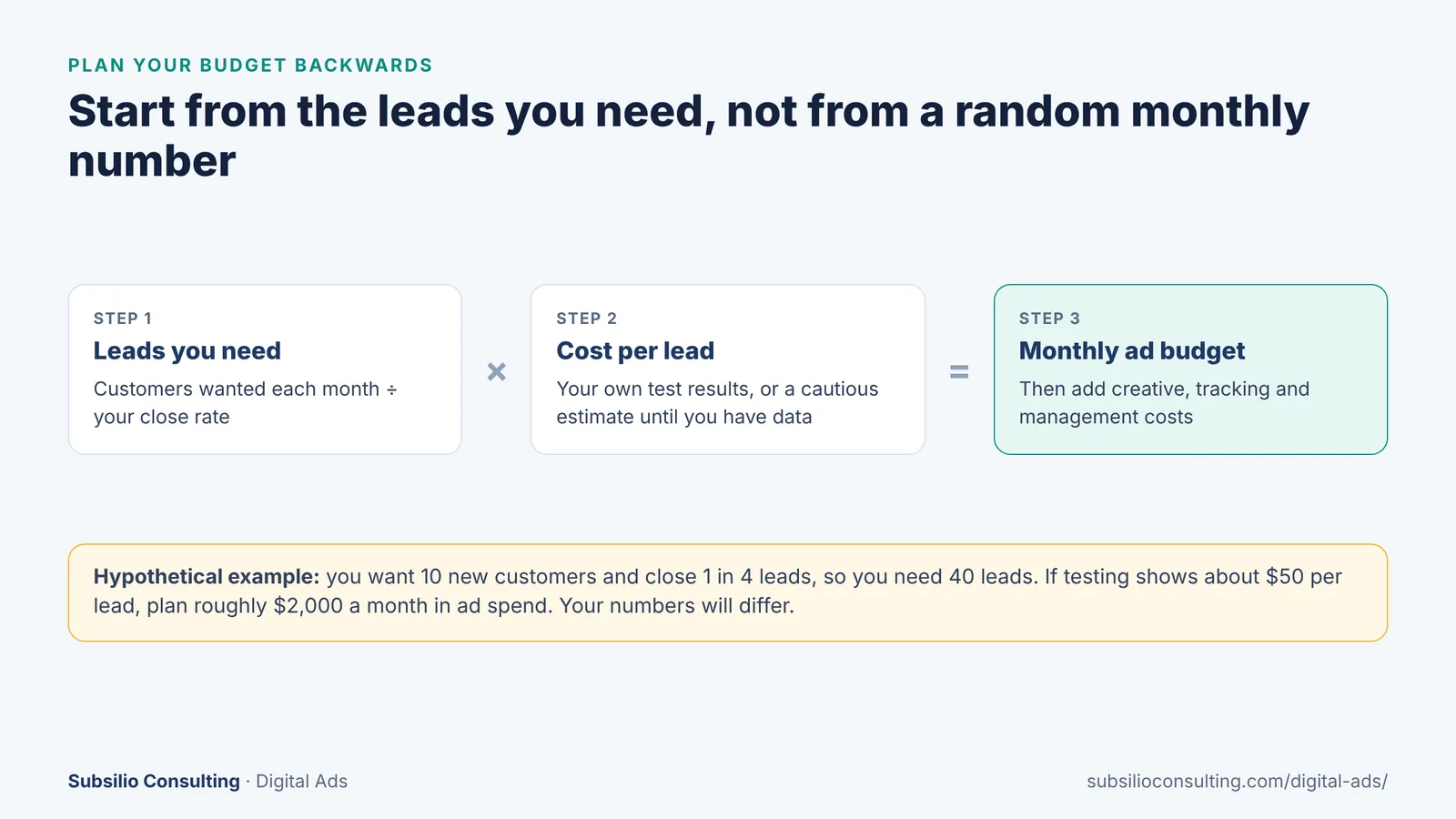
Work backward from the customers you need to find a budget that makes sense.
Instead of picking a random monthly number, work backward from your goals.
- Decide how many new customers you want each month.
- Estimate your close rate. If you typically win 1 out of every 4 leads, your close rate is 25%.
- Calculate the leads you need. New customers ÷ close rate. For 10 customers at a 25% close rate, you need 40 leads.
- Estimate your cost per lead. Use your own past results if you have them. If you don’t, run a short test to find out.
- Multiply. Leads needed × cost per lead = monthly ad spend.
- Check it against customer value. If a new customer is worth far more than what it costs to acquire them, the budget makes sense. If not, improve the offer, the landing page or the targeting before spending more.
Hypothetical example: you want 10 new customers, close 1 in 4 leads and find through testing that leads cost about $50 each. You would need 40 leads, or roughly $2,000 a month in ad spend. Your numbers will be different, which is why testing matters.
How much to spend on a first test
A first test should be large enough to collect real data, but small enough that you are comfortable if it doesn’t work. Give the campaign enough budget and time for Meta to deliver ads consistently and for you to see a meaningful number of results. Splitting a small budget across many ad sets and audiences usually means none of them gets enough data.
For guidance on testing creative and audiences without overspending, see our article on A/B testing paid ads on a small budget.
Don’t forget the costs beyond ad spend
- Creative: photos, short videos and graphics. Ads perform best when creative is refreshed regularly.
- Tracking setup: pixel, Conversions API, lead form connections.
- Landing pages: if you need pages built for campaigns.
- Management: your own time, or an agency or freelancer’s fee. For a sense of typical fee structures, read our guide to how much social media management costs in Denver.
How to Lower Your Facebook and Instagram Ad Costs
- Refresh creative regularly. New images, videos and headlines prevent fatigue.
- Lead with proof. Ads that feature real customer reviews and photos often build trust faster. Our reputation marketing service helps you gather that proof.
- Use short-form video. Vertical video fits Instagram Reels and Stories. Our guide on whether Instagram still works for small businesses covers what’s working.
- Retarget warm audiences. People who visited your website or engaged with your page are usually cheaper to convert than strangers.
- Exclude existing customers from acquisition campaigns so you don’t pay to reach people you already have.
- Fix your tracking. Better data helps Meta find better prospects.
- Improve the landing page. A faster page with a clearer offer lowers cost per lead.
- Avoid constant changes. Meta’s delivery system needs time to learn. Editing campaigns every day can reset that learning and raise costs.
Special Rules for Some Industries
If you advertise housing, employment, credit or financial services, or social issues and politics, Meta requires you to declare a special ad category. These categories limit some targeting options to prevent discrimination, which can change how you build audiences and what results to expect. Healthcare and other regulated businesses also face extra policy and privacy considerations. Plan for these before you launch, not after an ad is rejected.
Facebook Ads vs Other Channels
Facebook and Instagram ads are excellent for reaching people before they start searching: introducing a new service, promoting an offer, building local awareness or retargeting website visitors. They are usually less direct than Google Search ads, where people are actively looking for what you sell.
Many businesses get the best results by combining the two. If you are weighing your options, read our comparison of targeted advertising on Google vs social media and our guide to organic social media vs paid social ads.
Conclusion: Budget for Results, Not for Clicks
There is no single answer to “how much do Facebook and Instagram ads cost,” because Meta prices every impression through an auction. What you can control is what drives that price: your audience, your creative, your objective, your offer and your landing page. Get those right and the same budget goes much further.
The smartest way to plan is backward. Decide what results you need, test to find your real cost per lead, and set your budget from there. Then keep improving creative and conversion so your cost per lead keeps falling.
If you want help planning a Facebook and Instagram budget or improving campaigns that cost too much, our team manages paid social for businesses in Denver and beyond. Explore our digital ads services, see our social media services or request a free ad review.
Want a Budget Built on Real Numbers?
We will review your Facebook and Instagram ads and help you set a budget tied to the leads and customers you need.
Frequently Asked Questions About Facebook and Instagram Ad Costs
Q1. How much do Facebook ads cost for a small business?
There is no fixed price, because Facebook ads are sold through an auction. Your cost depends on your audience, competition, ad quality, objective, bid strategy and season. The best way to find your real cost is to run a well-tracked test and measure your cost per lead or sale.
Q2. Are Instagram ads more expensive than Facebook ads?
Neither is always more expensive. Both run through the same Meta auction, and costs vary by audience, placement and creative. Many businesses let Meta place ads across Facebook and Instagram together, which gives the system more options to find lower-cost results.
Q3. What is a good monthly budget for Facebook ads?
A good budget is one based on your goals. Multiply the number of leads you need by your expected cost per lead. Your first test should be large enough to collect meaningful data but small enough that you are comfortable if it needs adjusting. Add costs for creative, tracking and management.
Q4. Why are my Facebook ad costs going up?
Common reasons include more competition (especially around holidays), ad fatigue from showing the same creative too long, a very narrow audience, broken tracking, or frequent changes that reset Meta’s learning. Refreshing creative and checking tracking are usually the first fixes.
Q5. Do I pay for Facebook ads per click or per impression?
It depends on your settings, but most campaigns are charged per thousand impressions, even when they optimize for clicks or leads. Some setups allow paying per click. Regardless of how you are charged, judge success by cost per lead or sale.
Q6. What is the difference between cost per click and cost per lead?
Cost per click is what you pay, on average, for each click on your ad. Cost per lead is what you pay for each inquiry, such as a form submission, call or message. Cost per lead matters more, because it reflects your offer and landing page as well as your ad.
Q7. How can I lower my Facebook ad costs?
Refresh your creative regularly, use real customer proof, retarget warm audiences, exclude existing customers, fix your tracking, improve your landing page and avoid editing campaigns too often. These changes improve relevance and conversion, which lowers your cost per result.
Q8. Should I hire someone to run my Facebook ads?
If you don’t have time to test creative, manage tracking and review results weekly, professional management often pays for itself through lower costs per lead. Make sure any agency shows ad spend and management fees separately and reports on leads and sales, not just clicks.