
LOCAL SEO
How Many Google Reviews Do You Need to Rank in the Map Pack?
There is no magic number. Here is the forty-minute benchmark that gives you a real target, and where review count actually sits among Google’s ranking factors.
ESTIMATED READ TIME: 14 MINUTES
Want the benchmark run against your real competitors? We can do that.
There is no number. Google has never published a review threshold, no threshold exists in the algorithm as a fixed value, and any article that tells you “you need 47 reviews to rank” is making it up. What does exist is a way to work out the number that matters in your category, in your city, against the businesses you are actually competing with.
This guide gives you that method, explains where review count genuinely sits among Google’s local ranking factors, and covers the review practices that will get your profile restricted if you get them wrong, including a policy change most local businesses have not caught up with.
The short answer
You need enough reviews to be credible against the three businesses currently sitting in the Map Pack for your main keyword, usually somewhere between the median count of those three and about 20 percent above it. For a suburban dentist that might be 60. For a Denver personal injury firm it might be 400. For a rural HVAC company it might be 25.
The number is competitive, not absolute. And review count is only one input into one of three ranking factors, which is why businesses with fewer reviews routinely outrank businesses with more.
What the Map Pack actually is
The Map Pack, also called the local pack or the three-pack, is the block of three business listings with a map that appears near the top of Google’s results for searches with local intent. “Plumber near me.” “Dentist Denver.” “Emergency locksmith.”
It matters disproportionately because it sits above most organic results and captures the majority of mobile attention first. For a service business, a Map Pack position is usually worth more than a first-page organic position, because it produces calls and direction requests rather than clicks.
It is also a three-slot auction with no bidding. Everyone in your city is competing for the same three positions, and the composition changes depending on where the searcher is standing.
How Google says local ranking actually works
Google publishes this openly. In its guidance on improving local ranking, Google states that local results are based primarily on three factors: relevance, distance and prominence.
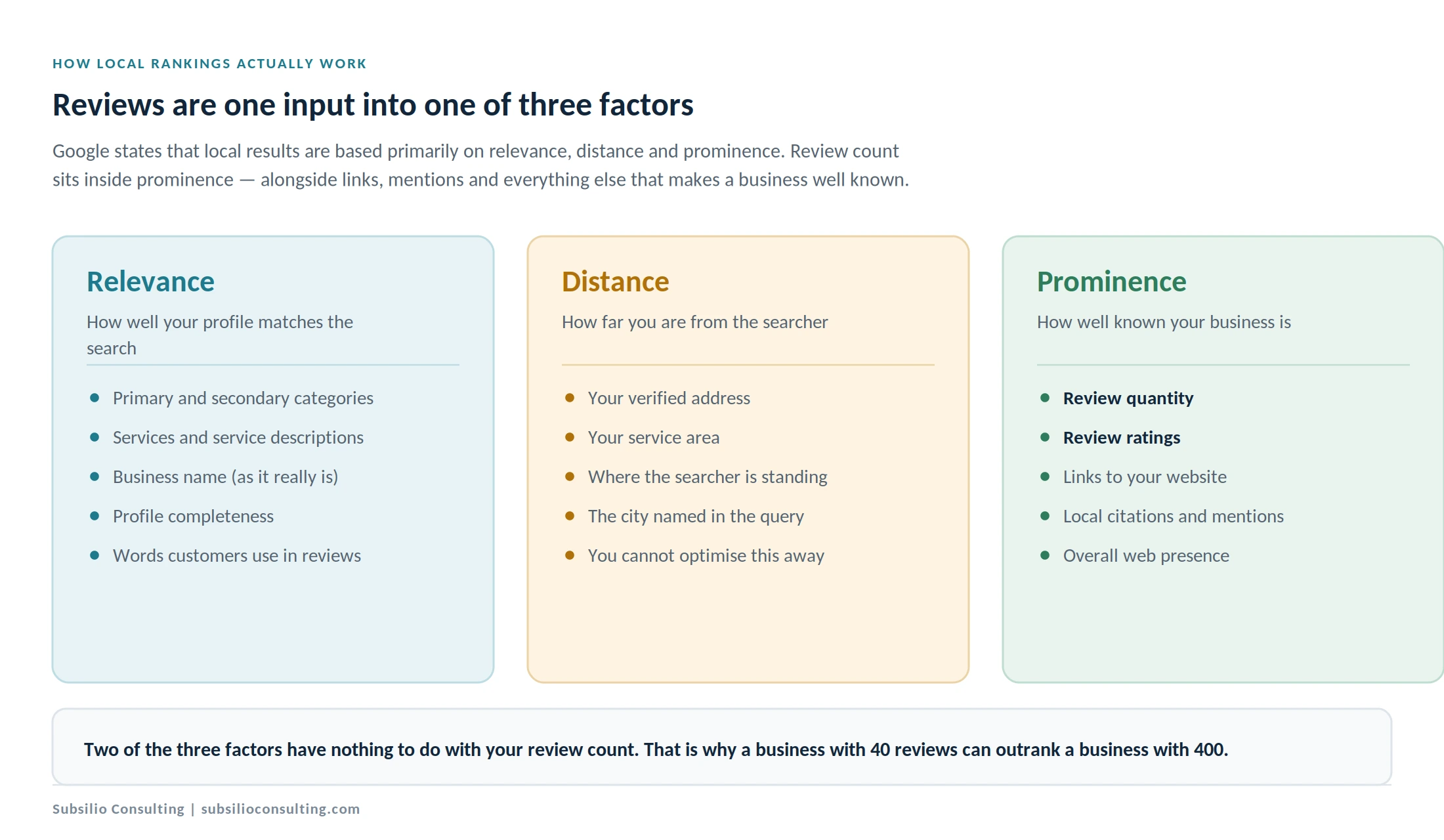
Review count sits inside prominence, alongside links, citations and mentions. Two of the three factors have nothing to do with reviews at all.
Relevance
How well your Business Profile matches what someone searched for. Google’s advice here is unglamorous: provide complete and detailed business information. Your primary category, your secondary categories, your service list, your business description, your attributes. A plumber whose primary category is “Contractor” is fighting relevance every single search.
Distance
How far your business is from the searcher, or from the location named in the query. If the searcher does not specify a location, Google uses what it knows about theirs. You cannot optimise this. You can only decide where you are verified and what service area you claim, and both of those need to reflect where you actually operate.
Prominence
How well known your business is. This is where reviews live. Google says the factor is based on information including how many websites link to your business and how many reviews you have, and states plainly that more reviews and positive ratings can improve your local ranking.
Read that sentence carefully. “Can improve.” Not “will.” Not “is the primary factor.” Reviews are one contributor to one of three factors, sitting alongside links, citations, mentions and general web presence.
Why there is no magic number
Five reasons the question does not have a numeric answer.
1. Distance overrides almost everything at close range. A searcher standing outside a competitor’s front door will usually see that competitor, regardless of your review count. This is why your rankings look different from your office chair than from across town.
2. Category competitiveness varies wildly. Median review counts in a metropolitan personal injury market and in a rural equipment repair market are not comparable numbers.
3. Relevance can beat prominence. A business with the exactly correct primary category and a detailed service list can outrank a better-known business with a vague category. Google explicitly says its algorithms might rank a business that is further away higher, if it is more likely to have what the searcher wants.
4. Reviews are only part of prominence. A business with 90 reviews and a genuinely authoritative website, real local press coverage and consistent citations is more prominent than a business with 300 reviews and nothing else.
5. Results are personalised and volatile. Two people searching the same term from two sides of the same suburb can see different three-packs. A single ranking check is not a measurement.
How to find your own number: a five-step benchmark
This takes about 40 minutes and gives you a defensible target instead of a guess.
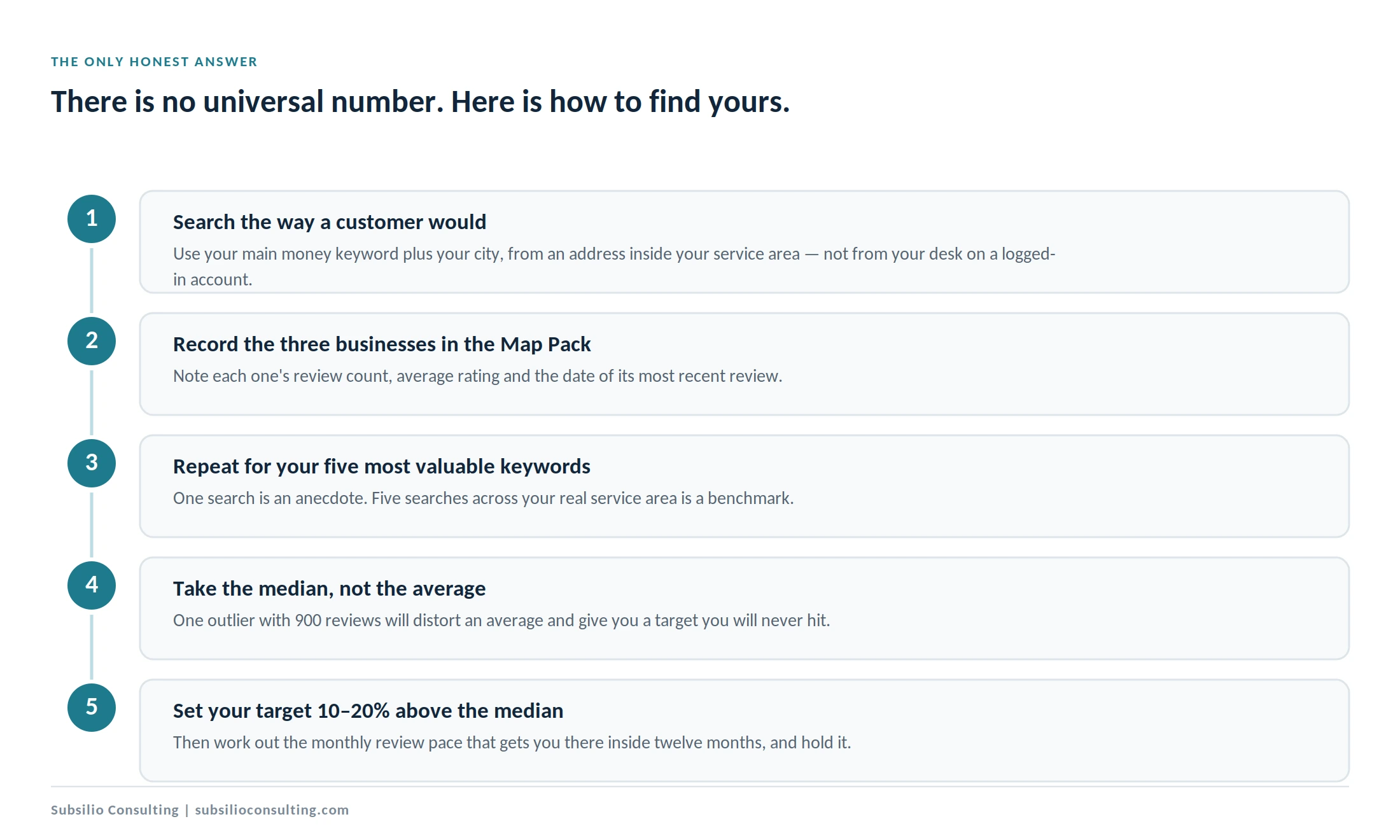
The only honest way to answer the question. Forty minutes of work beats any published benchmark.
Step 1: Search the way a customer would
Use your main money keyword plus your city. Search from an address inside your service area, not from your desk on a logged-in account with years of personalised history behind it. Use an incognito window at minimum. If you can, check from two or three points across your service area.
Step 2: Record what is in the Map Pack
For each of the three businesses, note: total review count, average rating, and the date of the most recent review. That third one matters more than most people realise.
Step 3: Repeat across your five most valuable keywords
One search is an anecdote. Five searches across your real service area is a benchmark. Include at least one “near me” variant and one that names a suburb rather than the city.
Step 4: Take the median, not the average
One outlier with 900 reviews will drag an average upward and hand you a target you will never reach. Sort the counts and take the middle one.
Step 5: Set your target 10 to 20 percent above the median
Then work backwards. If the median is 80 and you have 22, you need 74 reviews to reach 96. Over twelve months that is roughly six per month. That is a monthly operational target you can actually manage, which is the entire point of the exercise.
A worked example
A Denver residential painting company checks five keywords. The Map Pack counts across those searches are 112, 96, 58, 340, 74, 88, 61, 95, 130, 71, 84, 102, 66, 91 and 79. The median is 88. The average is 103, distorted by the 340 outlier. Target: roughly 100 to 106. Current count: 34. Gap: about 70 reviews, or six a month for a year.
That is a plan. “Get more reviews” is not.
Six signals that matter alongside count
Businesses that fixate on the total number usually neglect the signals that make the number believable.
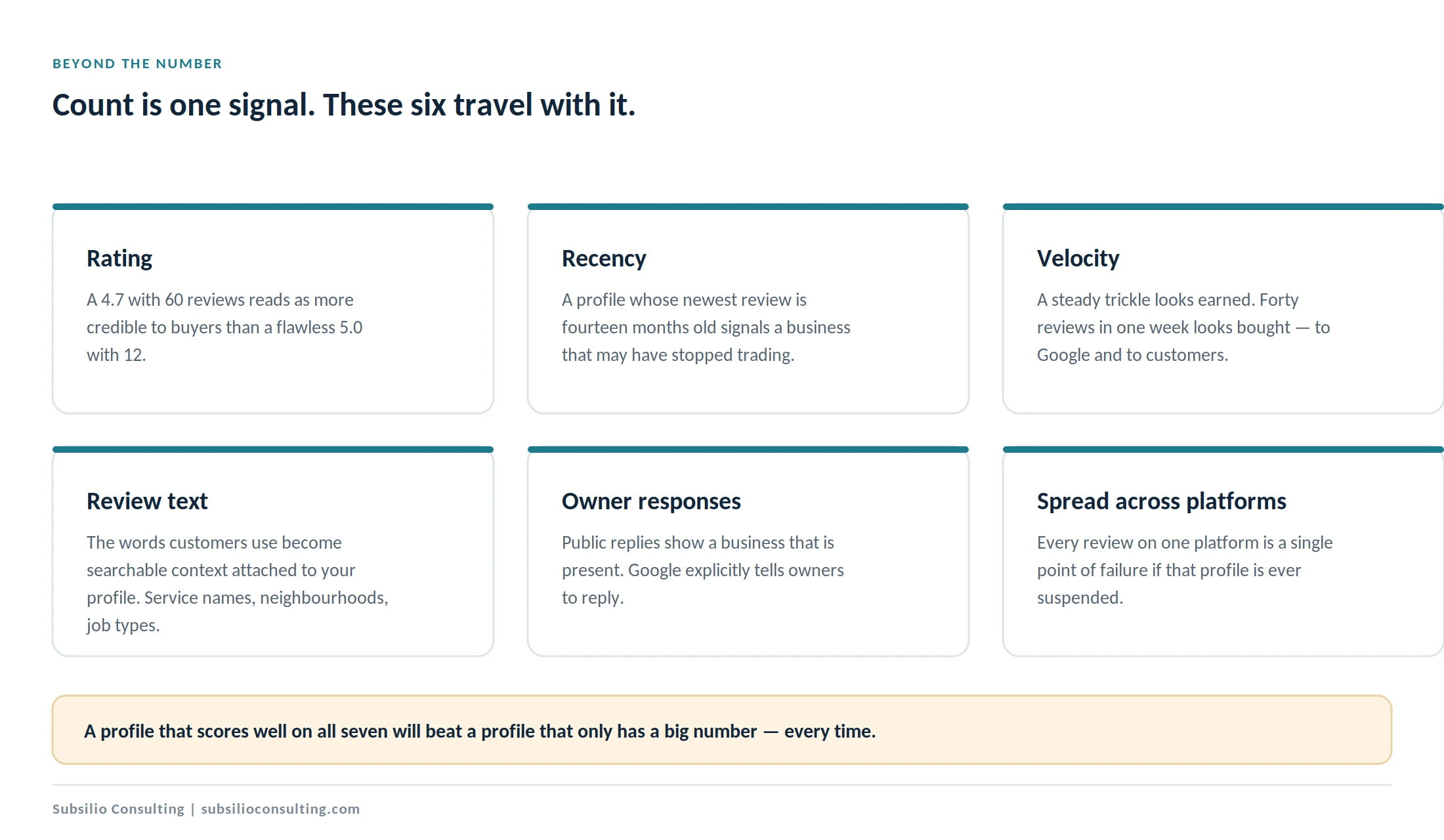
A profile that scores well across all of these beats a profile with only a big number.
Rating. A 4.7 with 60 reviews reads as more credible to a human than a flawless 5.0 with 12. Google’s own guidance to owners notes that a mix of positive and negative feedback often feels more authentic to customers.
Recency. A profile whose newest review is fourteen months old signals a business that may have stopped trading. Recency is a customer-trust problem before it is anything else.
Velocity. Steady beats spiky. Forty reviews in one week after two years of silence looks manufactured, to customers and to Google’s systems, which watch for unusual volumes or patterns of review contributions.
Review text. The words your customers use become context attached to your profile. Reviews that mention actual service names, job types and neighbourhoods are more useful than “Great service!”, though you cannot ask for specific wording, which we cover below.
Owner responses. Google tells owners directly to reply to reviews and says replies show customers their feedback matters. Reply rate is visible on your profile.
Spread across platforms. Every review on a single profile is a single point of failure. Profiles get suspended, merged and restricted. Concentration is a risk, not an efficiency.
How to get more reviews without breaking Google’s rules
This is the section that has changed, and where a lot of standard operating procedure is now a policy violation.
What Google explicitly prohibits
Under Google’s prohibited and restricted content policy, merchants must not:
- Offer incentives, payment, discounts, free goods or services, in exchange for posting a review, revising one, or removing a negative one.
- Discourage or prohibit negative reviews, or selectively solicit positive reviews.
- Require or pressure customers to leave a review while on the premises.
- Request that specific content be included in a review. Google now spells out two examples of this: directing staff to solicit a certain number of reviews, and directing staff to solicit reviews that include specific content, including content that identifies a staff member.
Those last two are the ones catching businesses out. Monthly staff review contests, review quotas tied to bonuses, and training your team to ask customers to “mention my name” have all been common practice in automotive, healthcare, home services and retail for years. All of them now sit on the wrong side of the policy.
Google states what it does allow just as clearly: soliciting or encouraging content that represents a genuine experience, without offering incentives and without attempting to influence the rating or the contents of the review.
Review gating is the fastest way to lose a profile
Review gating means filtering customers before you send the request, surveying them first and only sending the review link to the happy ones. Some software still markets this as a feature. It is selective solicitation of positive reviews, prohibited outright, and it is also covered by the FTC’s rule on consumer reviews and testimonials, which addresses review suppression practices and carries civil penalty authority.
If a vendor offers to pre-screen your customers, that is a disqualification, not a feature.
What a compliant request looks like
Short, open-ended, sent to everyone, with no steer on rating or content:
Hi Name, thanks for choosing us for your service last week. If you have a minute, we’d appreciate an honest review on Google: link. It genuinely helps other people in area decide. Either way, thanks again. – Your name
Note what is missing: no mention of stars, no “if you were happy with our service,” no staff name to include, no incentive, no follow-up chasing.
Practical mechanics
- Get your review link and QR code from your profile, Google documents this in its guidance on getting more reviews.
- Send at the point the value is obvious: after the job is finished and verified, not when the invoice goes out.
- SMS generally outperforms email for trades and appointment-based businesses. Email works better for B2B and higher-consideration services.
- Ask once. A second request is a nudge; a third is pressure.
- Send to every customer, not a selected subset.
What to do if your reviews disappear
Google removes reviews it believes violate policy, and enforcement has become more aggressive. If a batch vanishes:
- Check your profile’s reviews management tool for status messages.
- Look for the pattern, were they all from one time window, one location, one collection method?
- Stop whatever produced them. If review requests were going out through a kiosk, a tablet at the counter, or a staff contest, that is almost certainly the cause.
- Do not race to replace them. A volume spike immediately after a removal attracts further filtering.
- Understand the escalation path: Google can restrict a profile from receiving new reviews, or unpublish existing ones, for a set period. Its documentation on profile restrictions for policy violations sets out what that looks like.
Reviews and AI search
AI Overviews, AI assistants and answer engines increasingly sit between a search and a business. Two things are worth knowing.
First, Google’s own guidance on generative AI features in Search is blunt about tactics: it advises prioritising effective SEO over “AEO/GEO hacks,” and says content people find unique, compelling and useful will influence AI search visibility more than any other suggestion. There is no separate schema, no special markup, no review threshold for AI citation.
Second, one thing that trips up local businesses: adding review markup to your own website will not produce star ratings in search results. Google stopped displaying self-serving review rich results for LocalBusiness and Organization schema types, meaning reviews about you, placed on your own site, whether in your markup or through an embedded widget. The review snippet documentation confirms it. Display testimonials on your site because they convert visitors, not because you expect stars in the SERP.
You have more reviews than everyone and still don’t rank. Now what?
This is the most common version of the question we get, and it almost always comes down to one of these.
- Wrong primary category. The single highest-leverage field on the profile and the most commonly wrong.
- You are checking from the wrong place. Ranking from your office is not ranking. Check from across the service area.
- Distance is genuinely against you. If you are eleven miles out and your competitors are in the centre, review count will not close that gap for centre-of-city searches. Fight for the suburbs you can actually win.
- Thin website. Prominence includes your web presence. A three-page site with no service detail and no location pages limits what Google can attribute to you. This is where SEO work and profile work stop being separate projects.
- Inconsistent name, address and phone data across directories and your own site.
- A stale profile. No photos in two years, no posts, no answered questions, services list never updated.
- A suspended or duplicate listing splitting your signals.
- Service-area sprawl. Claiming forty suburbs you do not really serve weakens the signal for the ten you do. Our guide to local SEO for Denver small businesses goes deeper on this.
The bottom line
The question “how many reviews do I need” is really the question “what does credible look like in my market”, and that has a real, findable answer that takes under an hour to work out. Do the benchmark. Set a monthly pace. Hold it for a year.
Then spend the rest of your attention on the two factors that reviews cannot touch: getting your categories and service information genuinely right, and building the web presence that makes your business prominent for reasons beyond a star count. Businesses that treat reviews as the whole strategy tend to plateau. Businesses that treat reviews as one leg of three tend to hold their position.
If you would like a benchmark run properly against your real competitors, with the profile and website work that sits underneath it, that is the work we do. Take a look at our SEO services and reputation marketing approach, or get in touch and we will tell you plainly whether reviews are your bottleneck or a distraction from the one that is.
Or Have Us Run the Benchmark
Your real competitors, your real service area, and the profile and website work that sits underneath the number. That is what our SEO and reputation marketing work is built to do.
Frequently Asked Questions
Q1. How many Google reviews do you need to rank in the Map Pack?
There is no fixed number. Google has never published a review threshold and none exists as a fixed value. The practical target is the median review count of the three businesses currently in the Map Pack for your main keyword, plus roughly 10 to 20 percent. That figure varies enormously by category and city, it might be 25 in a rural market and 400 in a competitive metropolitan legal or medical category.
Q2. Do more Google reviews improve local rankings?
Google states that more reviews and positive ratings can improve local ranking. Reviews sit inside prominence, which is one of three primary local ranking factors alongside relevance and distance. So reviews help, but they are one input into one factor, which is why a business with fewer reviews can and regularly does outrank one with more.
Q3. Is a 5.0 rating better than a 4.7?
Not necessarily, and for human readers a small number of perfect reviews often looks less trustworthy than a larger volume with the occasional four star. Google’s own guidance to owners notes that a mix of positive and negative feedback often feels more authentic to customers.
Q4. How many reviews should you get per month?
Enough to close your competitive gap within about twelve months, and steady enough that the pattern looks earned. Divide your review gap by twelve and that is your monthly target. Avoid bursts, unusual volumes or patterns of review contributions are exactly what Google’s systems look for.
Q5. Can you ask customers to leave a Google review?
Yes. Google allows you to solicit or encourage content that represents a genuine experience, provided you offer no incentive and do not try to influence the rating or the content of the review. You cannot offer discounts or freebies, cannot pre-screen who gets asked, cannot set staff review quotas, and cannot ask customers to include specific content, including naming a staff member.
Q6. What is review gating and why is it a problem?
Review gating is surveying customers first and only sending review requests to the ones who respond positively. It is selective solicitation of positive reviews, which Google prohibits, and it is separately addressed as a review suppression practice under the FTC’s rule on consumer reviews. Any software that offers it as a feature is offering to put your profile at risk.
Q7. Do reviews on other platforms help Google rankings?
Indirectly at most. Prominence draws on your overall web presence, including mentions and citations. But your Google Business Profile reviews are what appear in the Map Pack, and that is where the direct effect sits. Diversify for risk and for buyer trust, not because you expect a ranking transfer.
Q8. Why did my Google reviews disappear?
Usually because they were removed under the fake engagement or rating manipulation policies. Common causes include incentivised requests, on-premises kiosks or tablets, staff review contests, and requests that steered content. Check your profile’s reviews management tool for status messages, stop the practice that caused it, and do not attempt to replace the volume quickly.
Q9. How long does it take for reviews to affect rankings?
There is no published timeline, and anyone quoting one is guessing. In practice, treat review building as a twelve-month compounding activity rather than a campaign with an end date. The businesses that win Map Pack positions are usually the ones that held a modest monthly pace for two years, not the ones that ran a review sprint.
Q10. Should I put review stars on my website?
Display testimonials because they help visitors convert. But do not expect star ratings in Google’s search results from them, Google does not display self-serving review rich results for LocalBusiness or Organization schema, which covers reviews about your business placed on your own site, including through embedded widgets.