
LOCAL MARKETING
Is Yelp Worth It for Small Businesses? Costs, Pros and Alternatives
Claim the free listing, always. Whether to pay for placement is a measurement question, and this is the framework that answers it.
ESTIMATED READ TIME: 13 MINUTES
Want an outside read on where your local budget is actually earning its keep?
Yelp generates strong opinions and very little clear thinking. Owners either swear it transformed their business or describe it as a protection racket. Both camps are usually arguing from a sample size of one.
Here is a straight assessment: claim your free Yelp listing, always, in every category, regardless of what you think of the company. Whether you should pay for placement is an entirely separate question, and for most small businesses the honest answer is “probably not, and definitely not until four other things are working.”
This guide covers what the free listing gives you, how the paid product actually charges you, the review policy that makes Yelp fundamentally different from Google, a decision framework to settle it for your business, and where the money usually performs better.
The short answer
- Free listing: yes, for everyone. It costs nothing but an hour, and an unclaimed listing works against you.
- Paid placement: only if your customers demonstrably use the platform, your category is one people browse before buying, you can respond to messages within minutes, and you can measure cost per booked job rather than cost per click.
- If you cannot meet all four of those: the same budget almost always performs better on your Google Business Profile, your website, and your response times.
What a free Yelp listing actually gives you
More than most owners realise, and it is the part that is genuinely worth doing.
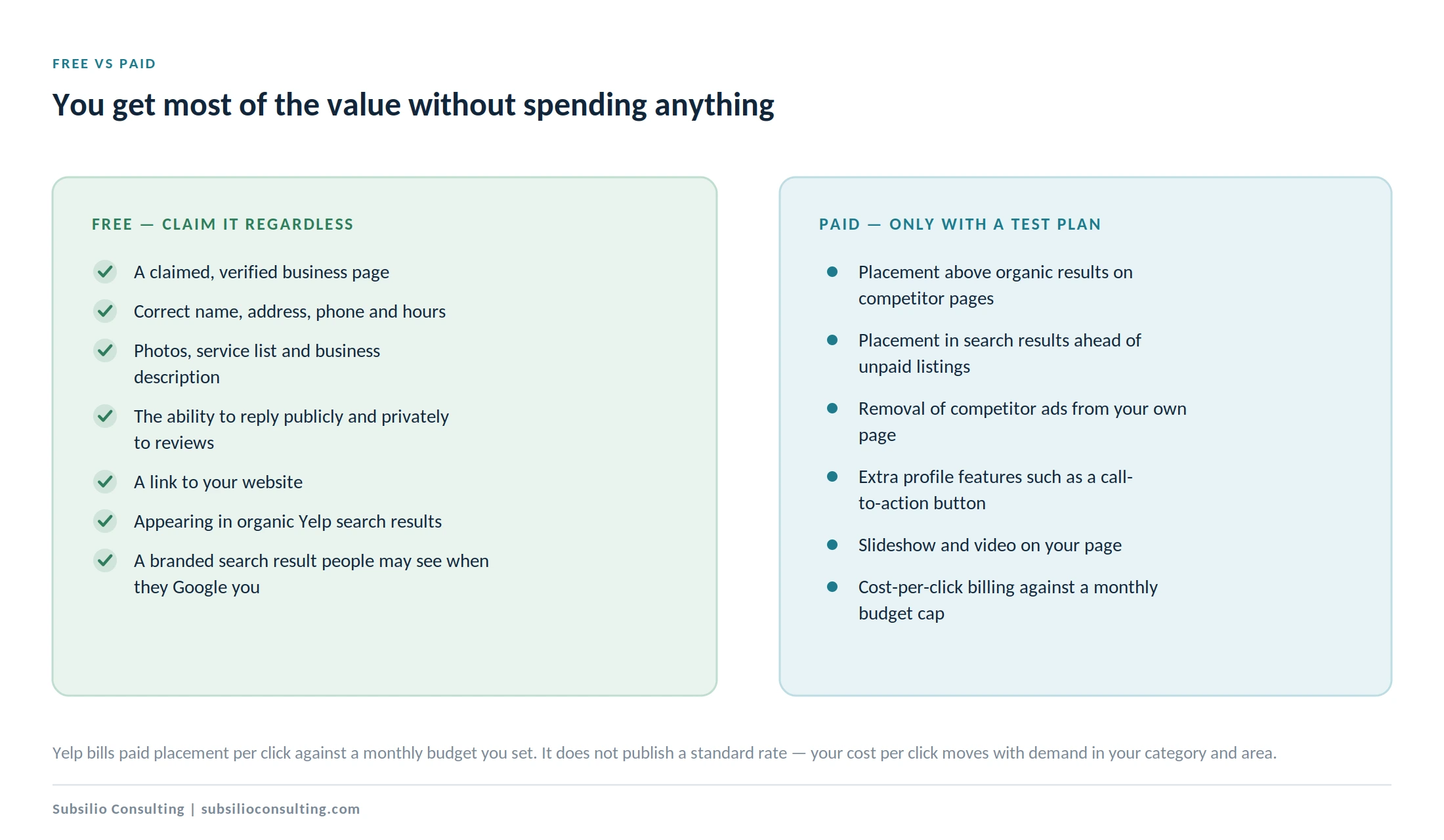
Most of the practical value sits on the left. The right-hand column is placement, not capability.
A claimed listing lets you control your name, address, phone number and hours; upload photos; describe your services; add a website link; and reply to reviews both publicly and privately. It appears in Yelp’s own organic search results, and it often surfaces as a branded result when someone searches your business name on Google.
That last point is the underrated one. Whether or not you engage with Yelp, a listing for your business may already exist, created by a user, populated with whatever information Yelp scraped, and possibly carrying reviews. An unclaimed listing with a wrong phone number and no photos is a liability. Claiming it costs an hour.
The one-hour setup
- Claim and verify the listing.
- Make the name, address and phone number identical to what appears on your website and Google Business Profile. Inconsistency across directories is a genuine local SEO problem.
- Set correct hours, including holidays.
- Upload twelve or more real photos. Not stock. Your premises, your team, your finished work.
- Write the business description in plain language, and list your services properly.
- Turn on message notifications and route them somewhere a human checks.
- Reply to every existing review.
What Yelp advertising actually costs
Yelp does not publish a rate card for clicks, and any article quoting you a definitive average cost per click is quoting a guess. What Yelp does publish is how the model works, and that is the part you need to understand before you sign anything.
According to Yelp’s own explanation of its cost-per-click advertising program, you are charged each time your ad is clicked, at a price that varies with supply and demand in the moment. That price depends on how many similar businesses are competing for the same clicks, available ad inventory and consumer interest, and it can move through the month with seasonality and the number of advertisers in your area. You set a monthly budget, and spend is not paced evenly, you might spend more in one week than another.
The practical implications:
- Your cost per click is not knowable in advance. Get the estimate Yelp shows for your own account and category. Do not budget against a figure from a blog post.
- The budget is a cap, not a forecast. Plan for the cap.
- Competitive categories cost more. Legal, home services, medical and anything with a high job value will run at the expensive end.
- Clicks are not leads and leads are not jobs. This is where most Yelp advertising post-mortems go wrong.
Read the agreement before you sign it
Yelp has sold advertising on annual terms and on shorter or month-to-month terms at different points and through different channels. Whether you can cancel without a fee depends on the specific agreement you signed. Do not assume month-to-month because a sales rep said “you can stop any time.” Find the term and cancellation clause in your own contract and read it. This is the single most common source of Yelp complaints and it is entirely avoidable.
The review policy that makes Yelp fundamentally different
This is the part most comparison articles skip, and it is the most important strategic difference between Yelp and Google.
You cannot ask customers for Yelp reviews. Not politely, not once, not by email, not with a card. Yelp’s policy on review solicitation is explicit: businesses should not ask anyone to review them, not customers, not mailing list subscribers, not friends or family, and proactively asking may hurt your rating, because Yelp’s automated software may decline to recommend reviews that appear prompted or encouraged.
Yelp has also said publicly, on its official blog, that its recommendation software actively targets solicited reviews, and that it has tuned the software to focus more heavily on them, including reviews contributed previously.
Compare that with Google, which explicitly permits asking, provided you do not offer incentives and do not attempt to influence the rating or the content. Two platforms, opposite rules. A single review-generation process cannot serve both, and any software or agency that promises to build your Yelp review count is either describing something that will not work or something that will get filtered.
The “not recommended” section
Yelp’s software decides which reviews are recommended and displayed prominently, and which are pushed to a separate not-recommended section that does not count toward your rating. Reviews can end up there for several reasons: apparent solicitation, a possible conflict of interest, or simply because the reviewer is new and Yelp does not have enough information about them to judge.
Yelp states that the software treats advertisers and non-advertisers identically. Take that at face value or don’t, but plan around the mechanism either way: on Yelp, your visible rating is determined by an algorithm you cannot influence through outreach. Your only real lever is the experience itself.
The case for Yelp
- Genuine buying intent in browse-first categories. Restaurants, bars, salons, med spas and some home services see users who are actively comparing options rather than idly researching.
- A branded search asset. Your Yelp page may appear when someone searches your business name, and a well-maintained page reinforces credibility.
- Reviews you did not have to ask for. Because solicitation is prohibited, Yelp reviews carry a different kind of credibility with sceptical buyers.
- Message-based lead flow. For service categories, Yelp’s request-a-quote flow produces direct inbound contact rather than just clicks.
- Free listing, real return. The claimed listing costs nothing and does useful work.
The case against
- You cannot build your rating. No review-generation strategy is available to you. On Google you can improve your position through legitimate effort; on Yelp you largely cannot.
- Legitimate reviews get filtered. Happy customers write reviews that end up not recommended, and there is no appeal.
- Leads are shared. Message-based leads often go to several businesses simultaneously. If you respond in four hours, you paid for a click someone else converted.
- Category dependence is severe. B2B, specialist professional services, most industrial suppliers and many trades called in an emergency see very little Yelp usage.
- Sales pressure. Persistent outbound sales calls are a widely reported experience and a reason many owners disengage.
- Contract friction. See above. Read the term.
- Your competitors’ ads may appear on your page unless you pay, a structural feature of the model that many owners find objectionable.
A decision framework
Four questions. If you cannot answer yes to all four, do not buy placement.
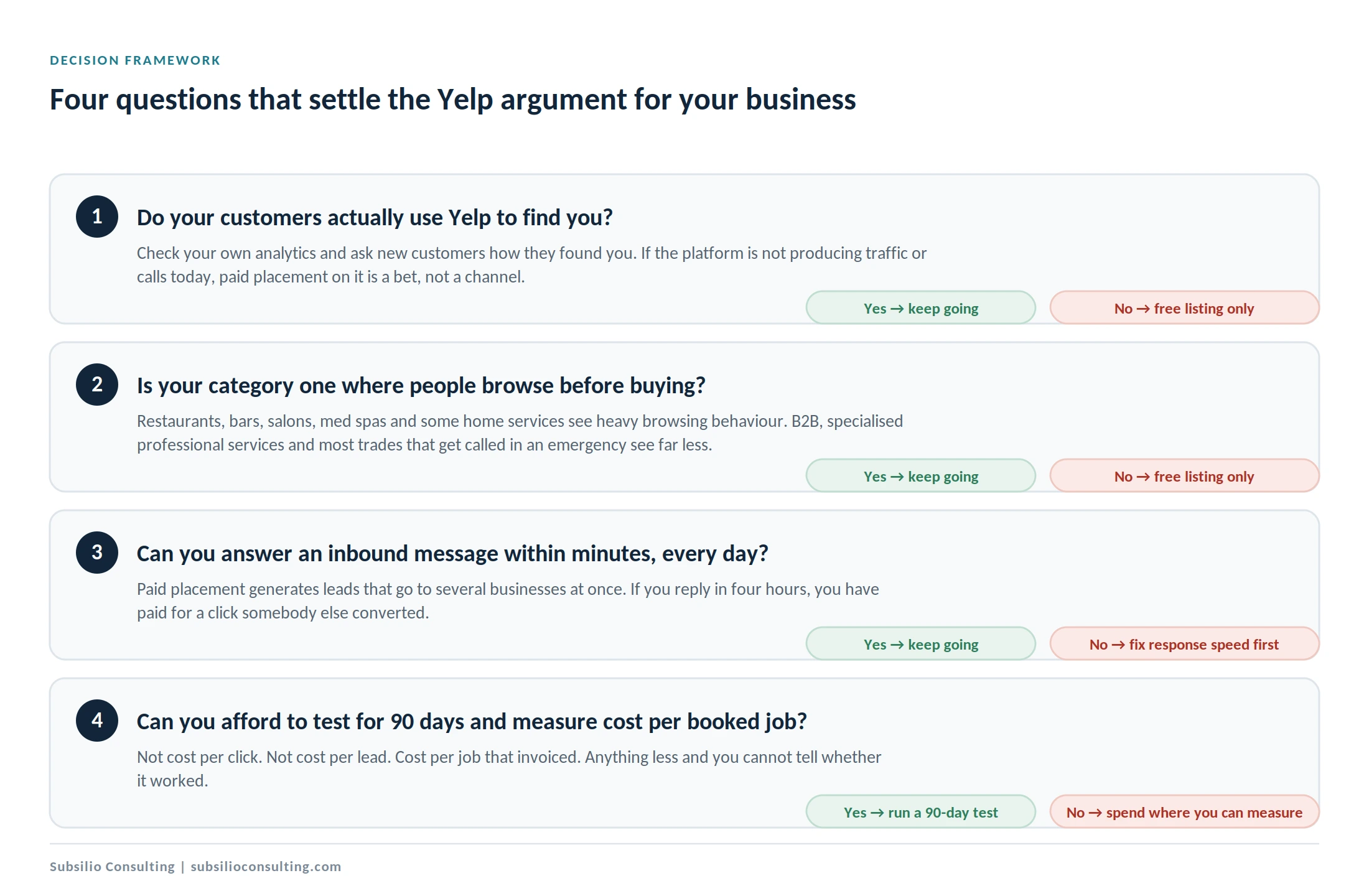
Work down the list. A single no means claim the free listing and put the budget elsewhere.
1. Do your customers actually use Yelp to find you?
Check your website analytics for referral traffic from the platform. Ask every new customer for a month how they found you and write the answers down. If the free listing is producing nothing today, paid placement on it is a bet, not a channel.
2. Is your category one where people browse before buying?
Restaurants, bars, salons, spas, dentists and some home services: yes. B2B services, specialist consultancies, industrial suppliers and emergency trades: largely no. Emergency buyers do not browse, they call the first credible result.
3. Can you respond to an inbound message within minutes, every day?
This is the question that decides more Yelp outcomes than budget does. Shared leads go to whoever answers first. If your process is “someone checks in the evening,” you will lose most of what you pay for.
4. Can you afford a 90-day test measured to cost per booked job?
Not cost per click. Not cost per lead. Cost per job that actually invoiced. If you cannot connect spend to revenue, you will not be able to tell whether it worked, and you will end up renewing on a feeling.
If you do advertise: how to run a proper test
- Set a fixed 90-day budget and do not increase it mid-test, regardless of what your rep suggests.
- Use a dedicated tracking phone number on the listing so calls are attributable.
- Tag the website link with campaign parameters.
- Log every inbound message with a timestamp, the response time, and the eventual outcome.
- Fix your profile before you start. Real photos, complete service list, current hours, replies on every existing review. Paying to send traffic to a thin profile is the most expensive mistake in this channel.
- Set a response-time standard. Under five minutes during business hours. If nobody owns this, do not start.
- At day 90, calculate one number: total spend divided by jobs booked and invoiced. Compare it to the same number for every other channel you run.
- Decide on the number, not on the relationship.
Where the money usually performs better
For most small businesses, the following four things return more per dollar than directory placement, and three of them are free.
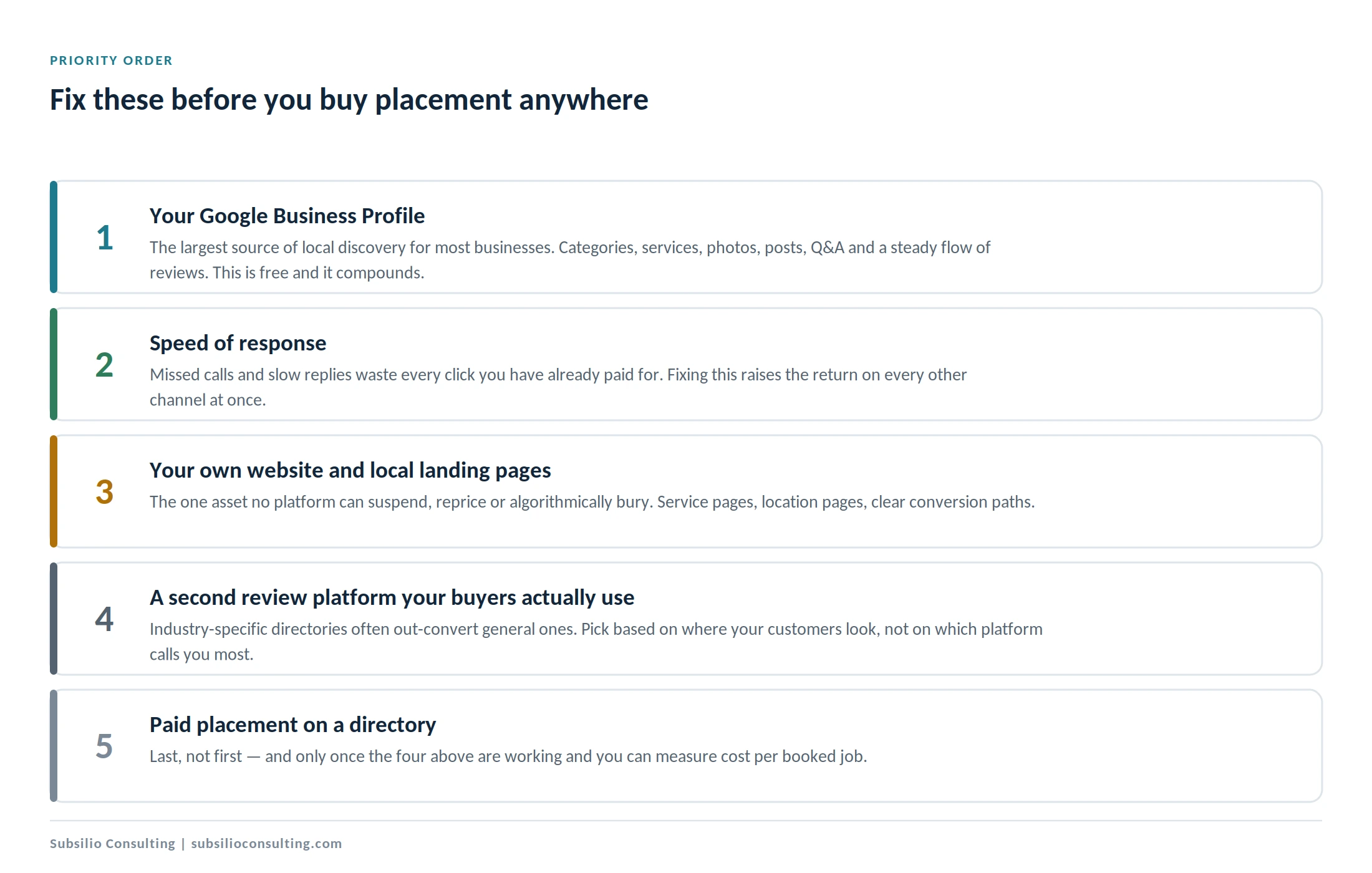
Paid placement is the fifth thing to fix, not the first. The four above it compound; placement stops the moment you stop paying.
1. Your Google Business Profile
The largest source of local discovery for most businesses, and free. Correct primary category, complete services, real photos, answered questions, and a steady flow of reviews that you are permitted to request. Google’s guidance on improving local ranking sets out what matters. Unlike paid placement, this compounds.
2. Response speed
Missed calls and slow replies waste every click you have already paid for on every channel simultaneously. Fixing this raises the return on everything else at once, and it usually costs less than a month of advertising.
3. Your own website and local landing pages
The only asset no platform can suspend, reprice or algorithmically bury. Proper service pages, location pages that reflect where you really work, and clear conversion paths. This is the foundation that makes every other channel cheaper. Our guide to local SEO for Denver small businesses covers the specifics.
4. A second review platform your buyers genuinely use
Industry-specific directories often out-convert general ones because the audience arrives pre-qualified. Choose based on where your customers actually look, not on which platform’s sales team calls you most often.
5. Then, and only then, paid placement
Once the four above are working and you can measure the cost per booked job.
Worth noting: paid search on Google reaches people typing a specific intent, which is a different and usually more valuable moment than someone browsing a directory. If you have budget for one paid channel, that comparison is usually where the conversation should start.
How this reads by industry
- Restaurants, bars, cafes: the strongest case for Yelp. Browse behaviour is real. Free listing essential; paid worth testing.
- Salons, spas, med spas: good case. Appointment-based and review-heavy research. Test paid.
- Home services (plumbing, HVAC, electrical, roofing): mixed. Can work well where response speed is genuinely fast, and can burn budget where it is not. Test carefully, measure to booked job.
- Dentists, chiropractors, vets: moderate. Free listing yes. Paid depends heavily on your local market.
- Law, accounting, financial services: weak in most markets. Buyers research differently. Free listing only.
- B2B, IT and managed services, industrial: weak. Your buyers are not on the platform. Free listing for consistency, nothing more.
- Retail: depends entirely on whether you rely on discovery foot traffic or on people already looking for you.
The bottom line
Claim the listing. It is free, it takes an hour, and leaving it unclaimed means a page about your business exists that you do not control.
Everything past that is a measurement question, not a philosophical one. If you can show that your customers use the platform, that you win shared leads on speed, and that the spend produces jobs at an acceptable cost, advertise. If you cannot show those things, the same money spent on your Google Business Profile, your response times and your own website will almost certainly do more, and it will keep working after you stop spending.
The businesses that get burned on directory advertising are rarely the ones who tried it. They are the ones who tried it without a measurement plan and renewed on instinct.
If you want an outside read on where your local marketing budget is actually earning its keep, that is what we do. See our approach to SEO and reputation marketing, or contact us for a candid assessment, including telling you when a channel is not worth it.
Or Have Us Audit Where the Budget Goes
A candid read on which channels are earning their keep, including telling you when one is not worth it. See our approach to SEO and reputation marketing.
Frequently Asked Questions
Q1. Is Yelp worth it for small businesses?
The free listing is worth it for essentially every local business, it costs an hour and gives you control over information that already exists publicly. Paid placement is worth it only where your customers demonstrably use the platform, your category involves browsing before buying, you can respond to inbound messages within minutes, and you can measure cost per booked job. For B2B, specialist professional services and most emergency trades, paid placement is usually the wrong choice.
Q2. How much does Yelp advertising cost?
Yelp bills per click against a monthly budget you set, and does not publish a standard rate. Yelp’s own documentation states that the price per click varies with supply and demand, competition in your category, available inventory and consumer interest, and can change through the month. Get the estimate shown in your own account for your category and area rather than relying on a published average, because there is no reliable one.
Q3. Can you ask customers to leave a Yelp review?
No. Yelp’s policy states that businesses should not ask anyone to review them, including customers, subscribers, friends or family, and that proactively asking may hurt your rating because its software may not recommend reviews that appear prompted. This is the opposite of Google’s position, which permits asking as long as you offer no incentive and do not influence the rating or content.
Q4. Why are some of my Yelp reviews not showing?
Yelp’s recommendation software decides which reviews are displayed and counted toward your rating, and moves others to a not-recommended section. Reviews can end up there because they appear solicited, because of an apparent conflict of interest, or simply because the reviewer is new and Yelp has limited information about them. There is no way for a business to have a review recommended.
Q5. Does advertising on Yelp improve your rating or review visibility?
Yelp states that its recommendation software does not favour advertisers, and that reviews from advertisers and non-advertisers are treated identically. Paid placement buys position in results, not review outcomes.
Q6. Can you remove a Yelp listing for your business?
Generally no. Listings can be created by users, and Yelp does not remove pages for businesses that are open and operating simply on request. The practical response is to claim the listing and manage it rather than to fight its existence.
Q7. Is Yelp better than Google Business Profile?
For nearly every local business, Google Business Profile is the higher priority. It is free, it feeds the Map Pack, it appears in far more searches, and it permits legitimate review generation. Yelp is a supplement in browse-first categories, not a substitute.
Q8. What should you do before paying for any directory placement?
Get your Google Business Profile complete and actively maintained, fix your response times, and make sure your website has real service and location pages. Those three compound and cannot be switched off by a platform. Paid placement stops working the day you stop paying.
Q9. How do you cancel Yelp advertising?
It depends entirely on the agreement you signed, terms have varied between annual and shorter arrangements. Find your specific contract, read the term and cancellation clauses, and follow the process set out there. Do not rely on a verbal assurance about month-to-month cancellation.
Q10. How do you know if Yelp is working?
One number: total spend divided by jobs booked and invoiced from the channel over a fixed period. Track it with a dedicated phone number on the listing and tagged website links. Cost per click and cost per lead both look fine while the channel loses money.