B2B ADVERTISING
LinkedIn Ads for B2B: How to Run Campaigns That Book Sales Calls
LinkedIn lets you target by job title, company and seniority. How to run campaigns that turn that precision into sales calls.
ESTIMATED READ TIME: 10 MINUTES
Want an outside read on whether your ads are earning their keep?
LinkedIn is the one major ad platform where you can target people by what they do for a living: their job title, seniority, company, industry and company size. For B2B companies, that is enormously valuable. You can put your message in front of operations directors at manufacturing companies in Colorado, or CFOs at mid-sized healthcare organizations, without paying to reach everyone else.
But LinkedIn ads also have a reputation for being expensive and disappointing. B2B firms often tell us they spent a meaningful budget, got a pile of form fills from people who weren’t buyers, and never booked a real sales conversation.
The difference between those outcomes usually isn’t the platform. It’s the plan. This guide explains how to run LinkedIn ads that lead to real sales calls: who to target, which formats to use, what to offer, how to budget and, most importantly, how to turn leads into conversations.
Key takeaways
- LinkedIn’s strength is professional targeting: job title, function, seniority, industry, company size and company lists.
- Campaigns that book sales calls usually run in stages: earn attention, re-engage interested people, then offer a clear next step.
- Lead gen forms make it easy to convert, but the offer and follow-up decide whether those leads become calls.
- LinkedIn’s minimum daily budget is $10 per campaign, but useful B2B testing usually needs more budget and patience than consumer ads.
- Measure success by qualified meetings and pipeline, not by clicks or cheap leads.
When LinkedIn Ads Make Sense for a B2B Company
LinkedIn ads are a strong fit when:
- Your buyers can be defined by job and company. For example, IT managers at companies with 50 to 500 employees.
- Each new customer is valuable. LinkedIn clicks often cost more than on consumer platforms, so the math works best when a client is worth a lot over time.
- Your sales cycle involves several touchpoints. LinkedIn is excellent for staying visible during long B2B decisions.
- You have a sales process to follow up. Leads need fast, personal follow-up to become meetings.
LinkedIn ads are usually a weaker fit if your customers are consumers, your average deal size is small, or no one is available to follow up on leads. If you’re earlier in the journey, our practical guide to LinkedIn for Denver B2B businesses covers organic LinkedIn strategy, which pairs well with ads.
The Three-Stage Campaign Structure That Books Calls
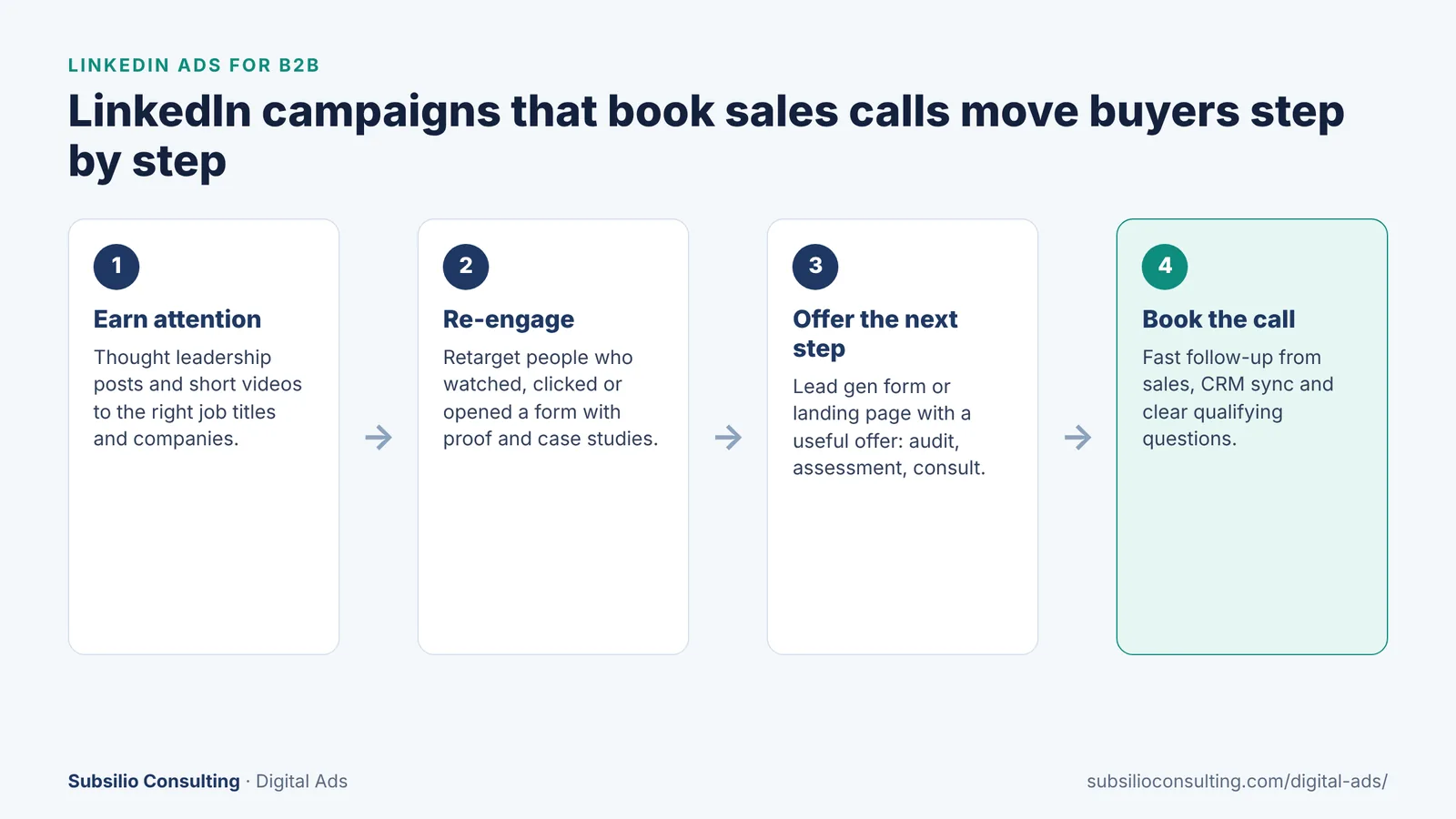
LinkedIn campaigns that book calls usually move people through stages instead of asking for a meeting on the first impression.
The most common mistake on LinkedIn is asking strangers for a sales call in the very first ad. Most B2B buyers aren’t ready to talk to sales after one ad from a company they don’t know. A staged approach works much better.
Stage 1: Earn attention
Reach your target audience with content that is useful on its own: a short insight, a point of view on an industry problem, a quick video, a case study summary or a post from a founder or expert at your company.
The goal here is not leads. It’s to build an audience of people who engaged with you: watched a video, clicked, or followed your page.
Stage 2: Re-engage interested people
Retarget people who engaged in Stage 1, visited your website or opened a lead form. Show them proof: case studies, client results, testimonials, explainer videos and comparison guides. These people already know your name, so the message can be more specific.
Stage 3: Offer a clear next step
Now make an offer worth exchanging contact details for:
- A free assessment, audit or consultation.
- A benchmark report or industry-specific checklist.
- A demo or working session.
- A webinar or event invitation.
The best offers give real value and naturally lead to a sales conversation.
Then: book the call
Follow up fast, personally and with context. More on this below, because it’s where most LinkedIn campaigns win or lose.
LinkedIn Targeting: Reach the Buyers, Not Just the Industry
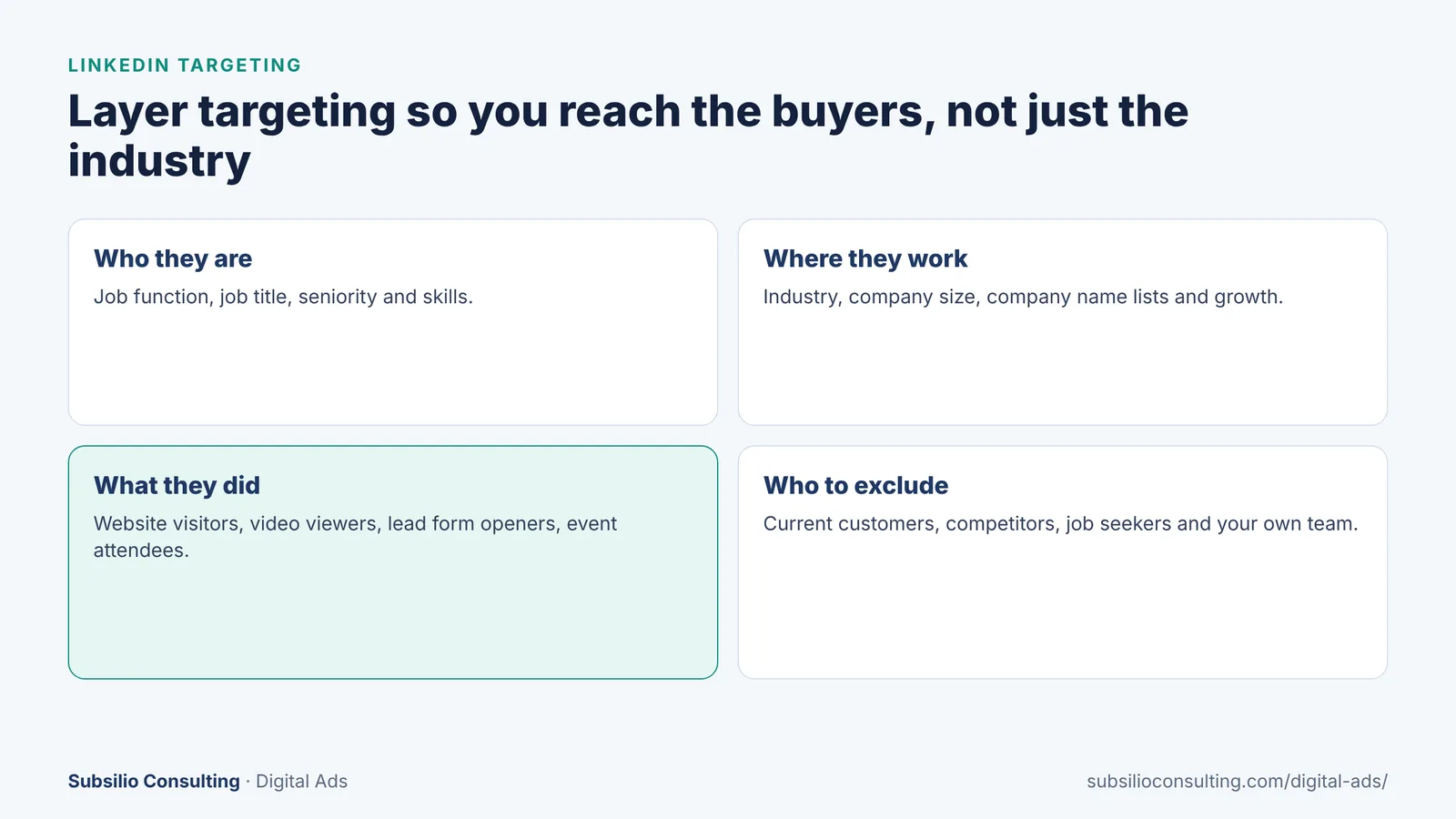
Layering professional, company and behavior targeting focuses budget on real buyers.
LinkedIn gives you several ways to define your audience. The best results usually come from combining them carefully:
- Who they are: job function, job title, seniority and skills. Function plus seniority is often more reliable than exact job titles, which vary between companies.
- Where they work: industry, company size, specific company names (from a target account list) and company growth.
- What they did: website visitors, video viewers, people who opened or submitted lead forms, event attendees and your own uploaded contact lists. These are often your best audiences.
- Who to exclude: current customers, your own employees, competitors, job seekers and junior roles that can’t make buying decisions.
Avoid making audiences so narrow that LinkedIn can’t deliver your ads, or so broad that most of the budget reaches people who will never buy. If you know exactly which companies you want to win, an account-based approach (uploading a target company list) can focus spend tightly.
Which LinkedIn Ad Formats to Use
| Format | What it is | Best stage |
|---|---|---|
| Single image ads | An image with a short headline in the feed | Awareness and offers |
| Video ads | Short videos in the feed | Earning attention and building retargeting audiences |
| Document ads | A guide or report people can preview in the feed | Education and lead generation |
| Thought Leader Ads | Promoting posts from individual people, such as founders or experts | Building trust and attention |
| Carousel ads | Several swipeable cards | Case studies and step-by-step stories |
| Lead gen forms | Forms that open inside LinkedIn, pre-filled with profile data | Converting interested prospects |
| Conversation and message ads | Messages delivered to LinkedIn inboxes | Event invitations and specific offers to warm audiences |
Format availability and names change over time, so check LinkedIn’s current options when you build a campaign. LinkedIn describes Thought Leader Ads as a way to promote posts from people at your company, which often feels more human than a company page post.
Lead Gen Forms vs Landing Pages
LinkedIn’s lead generation objective lets you collect leads with forms that open inside LinkedIn and are pre-filled with profile information. That makes it easy for people to respond, especially on mobile.
The trade-off is that easy forms can bring less committed leads. Here is how we usually decide:
- Use lead gen forms for content offers, events and audiences who already know you, especially on mobile.
- Use a landing page when the offer needs explanation, when you want visitors to book a time directly, or when you want stronger intent.
- Add qualifying questions to lead forms (company size, role, timeline) to separate buyers from browsers, but keep forms short.
- Connect forms to your CRM so leads reach sales instantly, not days later.
If you go the landing page route, a focused page built for the campaign almost always outperforms a general website page. Our web design team builds campaign landing pages for exactly this purpose.
How Much Do LinkedIn Ads Cost?
LinkedIn ad costs are set by an auction, so there’s no fixed price. Costs depend on your audience, competition for those professionals, your bid strategy and how relevant your ads are.
According to LinkedIn’s guidance on preparing your budget, the minimum daily budget is $10 for any ad format, and new campaigns with a lifetime budget have a minimum of $100. LinkedIn also suggests a default daily budget when you create a campaign.
In practice, the minimum is rarely enough to learn much in B2B. When planning a budget:
- Work backward from pipeline. How many qualified meetings do you need, and what is a meeting worth to you?
- Budget for all three stages, not just lead generation. Awareness and retargeting make the final offer cheaper.
- Give tests time. B2B audiences are smaller and decisions slower, so judge results over weeks, not days.
- Measure cost per qualified meeting, not cost per click or even cost per lead.
Turning LinkedIn Leads Into Sales Calls
This is where most campaigns fail. A lead form submission is not a sales opportunity until someone follows up well.
- Respond quickly. Reach out the same business day, while your offer is still fresh in their mind.
- Reference what they asked for. “Thanks for downloading our manufacturing IT checklist” is far better than a generic sales email.
- Deliver value first. Send what was promised, plus one useful insight specific to their company or role.
- Offer an easy next step. A short call with a clear agenda, and a booking link to make it easy.
- Follow up more than once. Use a short sequence of emails and, where appropriate, LinkedIn messages.
- Track outcomes. Record which leads became meetings, opportunities and clients, and feed that back into targeting and offers.
Content That Works in B2B LinkedIn Ads
- Specific problems: speak directly to a challenge your buyer faces, in their language.
- Proof: case studies, client quotes and before-and-after results (with permission and without overstating them).
- People: faces and voices from your team build trust, especially in professional services.
- Useful insights: practical tips that show expertise, not just claims about it.
- Clear offers: one call to action per ad.
For a broader content plan, see our guides on social media strategy for professional services and building an effective content strategy for Denver service firms.
Common LinkedIn Ads Mistakes
- Asking for a sales call in the first ad to cold audiences.
- Targeting by industry alone, without seniority or function.
- Leaving audience expansion turned on without checking who you’re reaching.
- Weak offers such as “Contact us to learn more.”
- Lead forms with no qualifying questions, or forms that ask too much.
- No CRM connection, so leads sit unanswered.
- Judging results by cost per click instead of qualified meetings.
- Stopping campaigns before B2B buyers have had time to move through the stages.
Conclusion: LinkedIn Rewards Patience and Precision
LinkedIn is the most precise way to reach B2B decision-makers with paid advertising. It isn’t the cheapest platform, and it doesn’t reward shortcuts. The campaigns that book sales calls target buyers carefully, earn attention before asking for a meeting, offer something genuinely useful and follow up quickly and personally.
Treat LinkedIn ads as a pipeline-building system, not a lead vending machine. Measure success in qualified conversations and new clients, and the higher cost per click starts to make sense.
If you want help planning or improving your LinkedIn advertising, our team builds B2B campaigns on LinkedIn alongside Google Ads, retargeting and content. Explore our digital ads services, see our social media services or book a free consultation.
Ready to Fill Your Calendar With Qualified Calls?
We plan and run LinkedIn campaigns built around one goal: booked conversations with the right decision makers.
Frequently Asked Questions About LinkedIn Ads for B2B
Q1. Are LinkedIn ads worth it for B2B companies?
LinkedIn ads are often worth it for B2B companies with clearly defined buyers, valuable clients and a long sales cycle, because LinkedIn can target people by job, seniority, company and industry. They work best with a staged campaign, strong offers and fast sales follow-up. Measure results by qualified meetings and pipeline.
Q2. How much do LinkedIn ads cost?
LinkedIn ads are priced through an auction, so costs depend on your audience, competition, bids and ad relevance. LinkedIn’s minimum daily budget is $10 per campaign, with a $100 minimum for new lifetime-budget campaigns. Most B2B tests need more than the minimum to produce meaningful results.
Q3. What is the minimum budget for LinkedIn ads?
According to LinkedIn, the minimum daily budget is $10 for any ad format, and new campaigns with a lifetime budget need at least $100. These are platform minimums, not recommendations. Plan your budget around the number of qualified meetings you need.
Q4. Should I use LinkedIn lead gen forms or a landing page?
Lead gen forms are easier to complete and work well for content offers, events and warm audiences. Landing pages suit offers that need more explanation or direct booking. Add a few qualifying questions to lead forms and connect them to your CRM for fast follow-up.
Q5. Who should I target with LinkedIn ads?
Target the people who make or influence buying decisions, usually by combining job function, seniority, industry and company size. Retarget website visitors and people who engaged with your content. Exclude current customers, employees, competitors and job seekers.
Q6. Why are my LinkedIn ads getting leads but no sales calls?
Common reasons are offers that attract researchers rather than buyers, targeting that is too broad or too junior, forms without qualifying questions, and slow or generic follow-up. Use a staged campaign, add qualifying questions and contact leads quickly with a personal, relevant message.
Q7. What are LinkedIn Thought Leader Ads?
Thought Leader Ads let companies promote posts published by individual people, such as founders, executives or subject-matter experts, to targeted audiences. They often feel more personal and credible than company page ads, which makes them useful for building trust with B2B buyers.
Q8. How long does it take to see results from LinkedIn ads?
You can see engagement and early leads within days, but B2B buying decisions take longer. Give campaigns several weeks to build retargeting audiences and test offers, and judge success over a full sales cycle by qualified meetings and new clients.