
LOCAL ADVERTISING
Geofencing Marketing for Local Businesses: How It Works, What It Costs and Is It Legal?
Reach people based on where they have been. How geofencing works, what drives the cost, and where the legal lines sit in Colorado.
ESTIMATED READ TIME: 14 MINUTES
Want an outside read on whether your ads are earning their keep?
Picture this: a home show is running at a convention center across town, and hundreds of homeowners who are planning a remodel are walking the aisles. You are not exhibiting. With geofencing marketing, you can still reach the people who were there, with an ad that reaches their phone after they leave.
That is the promise of geofencing. It lets a local business reach people based on where they have been, not just what they typed into a search box. Used well, it fills the gap between “people near us” and “people ready to buy.” Used carelessly, it wastes budget and can create real privacy problems.
This guide explains how geofencing works, how it differs from geotargeting, what drives the cost, which businesses get the best results, and where the legal lines are, including what Colorado businesses need to know. It is written from what our team sees when we plan and run location-based campaigns for local businesses in Denver.
Key takeaways
- Geofencing marketing shows ads to people whose mobile devices were inside a virtual boundary you draw, such as an event venue, neighborhood or shopping district.
- It is different from geotargeting, which simply limits ads to people in a broad area like a city or zip code.
- Cost depends on audience size, how long you keep showing ads, the ad formats you use and how the campaign is managed.
- There is no single price.
- Geofencing is legal when the location data is collected with consent and you avoid sensitive locations.
- Colorado treats precise geolocation as sensitive data.
- It works best for businesses with a clear local area, a visual offer and a defined buying window.
What Is Geofencing Marketing?
Geofencing marketing is a form of location-based advertising. You draw a virtual boundary, called a geofence, around a real place. When a mobile device that shares its location enters that boundary, it can be added to an advertising audience. You then show ads to that audience, usually across mobile apps, websites and sometimes video and streaming platforms.
The geofence can be almost any shape. Some campaigns use a circle around a single building. Others trace the outline of a parking lot, a stadium, a trade show hall or a group of streets. The key idea is precision: you are not targeting “Denver,” you are targeting people who were at a specific place, at a specific time.
Most geofencing campaigns work in two parts:
- Capture: devices are collected while they are inside the fence during the dates and hours you choose.
- Follow-up: ads are shown to that audience for a set period afterward, often days or weeks.
Some campaigns also use “conversion zones,” which are separate geofences around your own business. These help estimate how many people who saw an ad later visited your location. Treat those reports as estimates, not exact counts, because location signals are not perfect.
How Geofencing Ads Work, Step by Step
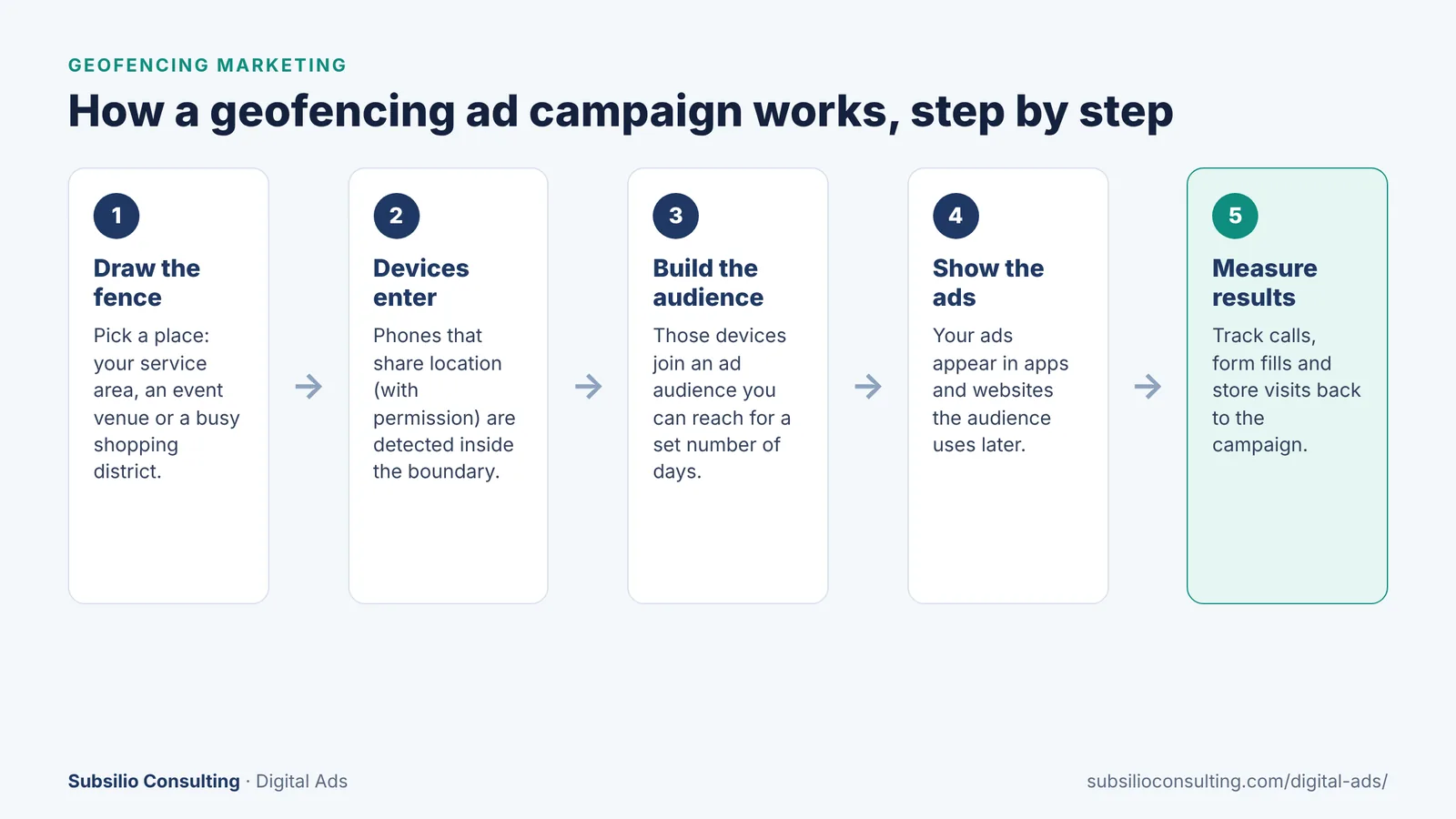
The five stages of a typical geofencing campaign.
Here is how a typical campaign runs from start to finish.
- Choose the place and the time. Decide where your future customers gather. That could be your own service area, a home and garden show, a sports venue, a university campus or a business district. Then set the dates and hours that matter, such as the hours an event is open.
- Draw the boundary. Your agency or ad platform draws the geofence on a map. Tighter boundaries reduce wasted impressions from people who were only passing by.
- Collect the audience. Devices that share location data through apps (with the user’s permission) and enter the fence are added to the audience.
- Show relevant ads. The audience sees your ads in apps and websites they use afterward. The ad should connect to the place: “Visited the home show? Get a free kitchen design consult this month.”
- Measure what happened. Track calls, form fills, website visits and, where available, estimated store visits. Compare results with a control period or a similar campaign without geofencing.
Good geofencing is less about the fence and more about the message. If the ad does not make sense for someone who was at that place, the precision is wasted.
Geofencing vs Geotargeting vs Radius Targeting
These terms are often used as if they mean the same thing. They don’t, and the difference affects what you pay for and what results you can expect.
| Method | What it targets | Best for | Main limitation |
|---|---|---|---|
| Geotargeting | People in, or interested in, a broad area such as a city, county or zip code | Search ads and social ads for a service area | Broad: includes many people who are not in-market |
| Radius targeting | People within a set distance of a point, such as your shop | Businesses whose customers come from nearby | A circle rarely matches real customer areas |
| Geofencing | Devices that were inside a precise boundary during a set time | Events, competitor-heavy areas, neighborhoods, business parks | Smaller audiences, and needs careful privacy practices |
| Conversion zones | Devices from the audience that later enter your location | Estimating store or office visits | Estimates only; depends on location signal quality |
Most local businesses use more than one. For example, a remodeler might use Google Search ads geotargeted to the metro area to catch active searches, and a geofence around a home show to reach people still in research mode. Search ads capture demand that already exists. Geofencing creates awareness with people likely to need you soon.
If you are running Google Search ads, Google’s own guide to targeting ads to geographic locations explains the location and radius options available there. For more on how local search ads and social ads differ, see our guide to targeted advertising on Google vs social media.
What Does Geofencing Marketing Cost?
There is no standard price for geofencing, and any agency that quotes one before understanding your goals is guessing. What you pay is shaped by several factors.
The factors that drive cost
- Audience size. A fence around a large venue during a multi-day event collects far more devices than a fence around a small office building. More devices usually means more impressions to pay for.
- How long you follow up. Showing ads to an audience for 30 days costs more than showing them for 7 days.
- Ad formats. Static display ads usually cost less to run than video or streaming TV placements.
- Frequency. How many times each person sees your ad. Too low and they forget you. Too high and you waste money and annoy people.
- Pricing model. Most geofencing inventory is bought on a cost-per-thousand-impressions (CPM) basis, not per click.
- Minimum spends. Many location data and ad-buying providers set minimum campaign budgets.
- Management and creative. Planning the fences, writing and designing ads, setting up tracking and reporting all take time.
How to estimate your budget
Rather than asking “how much does geofencing cost,” ask “how many people do I need to reach, how often, and for how long?” A simple way to frame it:
Budget ≈ (people in the audience × ads each person sees) ÷ 1,000 × CPM, plus management and creative.
Your agency should be able to give you an estimated audience size for each fence and a CPM range for the formats you plan to use. Ask them to show this math in writing.
Signs you are overpaying
- You cannot see how many devices each fence collected.
- Reports show impressions only, with no link to calls, form fills or website visits.
- The same ad runs for months without new creative.
- You are paying for fences around places your customers don’t actually go.
Which Businesses Get the Best Results From Geofencing?
Geofencing is not right for everyone. It tends to work best when three things are true: there is a clear physical place where your customers gather, your offer is easy to understand from a small mobile ad, and there is a buying window you can catch.
Good fits we see often include:
- Home services and remodelers: fencing home shows, new housing developments and design centers.
- Auto repair and dealerships: fencing the service areas around your shop or busy commuter corridors.
- Restaurants, retail and entertainment: fencing nearby offices, events and shopping areas to drive visits.
- Real estate: fencing open houses and new communities, while following housing-ad rules on each platform.
- Professional services and B2B: fencing trade shows, conferences and business parks.
- Event-driven businesses: fencing sports venues, festivals and concerts for timely offers.
Geofencing is usually a weak fit when your customers have no physical gathering point, your sales cycle is very long and complex, or your budget can only support one channel. In that last case, search ads usually come first because they reach people who are already looking.
For more ideas on tying your marketing to local happenings, see how Denver businesses can use local events to boost SEO. The same event calendar can guide your geofencing plan.
Is Geofencing Legal?
In the United States, geofencing for advertising is generally legal. The legal risk comes from how location data is collected, which places you target and how the data is used. The rules are tightening, so this section matters more than it did a few years ago.
This section is general information, not legal advice. If your business is in a regulated industry or targets sensitive places, talk to a privacy attorney before launching.
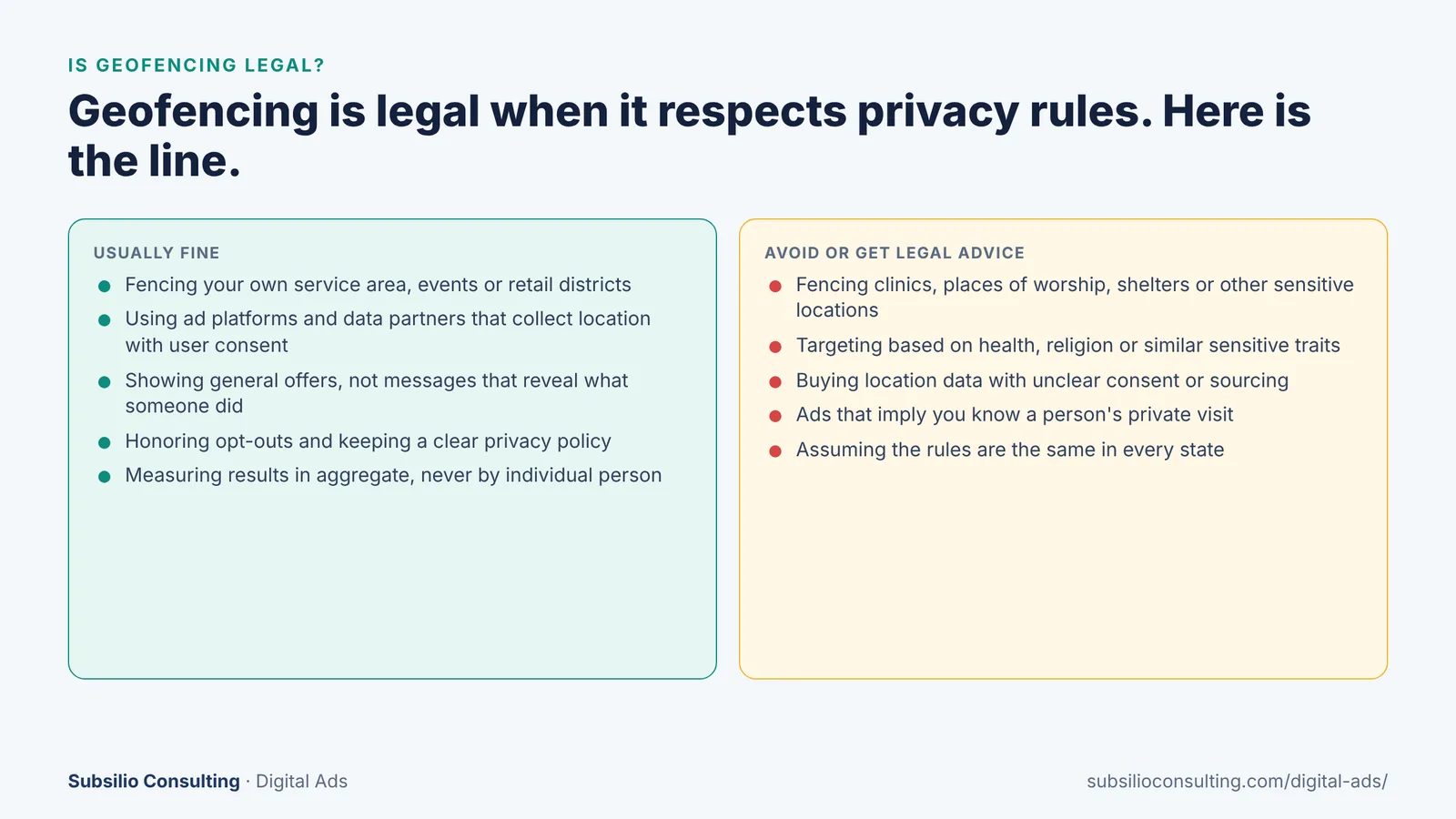
Where the legal lines usually sit for geofencing campaigns.
What Colorado businesses should know
The Colorado Privacy Act applies to businesses that operate in Colorado or target Colorado residents and meet certain thresholds. According to the Colorado Attorney General, those thresholds are processing the personal data of more than 100,000 Coloradans in a year, or earning revenue or discounts from selling the personal data of 25,000 or more Coloradans. The law gives consumers the right to opt out of targeted advertising and requires consent before processing sensitive data.
In 2025, Colorado passed SB25-276, which added “precise geolocation data” to the law’s definitions and prohibits selling a consumer’s sensitive data without first obtaining consent. In plain terms: precise location data now sits in the most protected category of personal data in Colorado.
Most small businesses do not collect location data themselves. Your ad platform or data partner does. But you are still responsible for choosing partners who collect it properly. Ask any provider how their location data is sourced and how consent is obtained.
Federal enforcement and sensitive locations
The Federal Trade Commission has acted against companies that sold location data revealing visits to sensitive places. In one 2024 FTC order, a data broker was barred from sharing or selling sensitive location data after the FTC alleged it sold data that could reveal visits to medical clinics and places of worship. The order also required the company to keep a list of sensitive locations and avoid sharing data about them.
The lesson for advertisers is simple: never draw a geofence around a sensitive location. That includes healthcare facilities, places of worship, shelters, addiction treatment centers and similar sites.
Platform rules still apply
Ad platforms have their own rules on top of the law. Google, for example, restricts advertiser-curated audiences in sensitive interest categories such as health, religious beliefs and negative financial status. If your business falls into one of these categories, some audience-based tactics may not be available to you at all.
A practical compliance checklist
- Use reputable ad platforms and data partners that can explain how they obtain consent.
- Keep fences around commercial and public places, not sensitive locations.
- Make sure your website privacy policy explains how you use advertising data.
- Respect opt-outs, including universal opt-out signals where required.
- Write ads that do not suggest you know where a specific person has been (“We saw you at the clinic” is a line you never cross).
- Review the plan with legal counsel if you are in healthcare, finance, housing or another regulated industry.
How to Plan a Geofencing Campaign That Actually Pays Off
Here is the process we follow when we plan location-based campaigns for local clients.
- Start with the customer, not the map. Write down where your best customers spend time in the weeks before they buy. That list becomes your fence list.
- Pick one clear goal. Phone calls, booked consultations, store visits or online sales. One campaign, one goal.
- Match the message to the place. Someone leaving a home show needs a different ad than someone leaving a sports game.
- Keep the follow-up window realistic. Match it to your buying cycle. A restaurant offer may only need a few days. A remodel may need several weeks.
- Build a landing page for the campaign. Send people to a page that repeats the offer, not your home page. Our web design team builds fast, mobile-friendly pages for exactly this.
- Add proof. Reviews and ratings in your ads and on your landing page build trust with people who have never heard of you. Our guide on leveraging social proof with user-generated content covers how.
- Retarget website visitors. People who click your geofencing ad and leave without calling can be shown follow-up ads. See our guide to retargeting for how this works.
- Measure against a baseline. Compare calls, leads and visits before, during and after the campaign. Look at cost per lead, not just impressions.
Common Geofencing Mistakes to Avoid
- Fences that are too big. A fence that covers half a neighborhood behaves like broad geotargeting, and you lose the precision you are paying for.
- Fencing competitors without a better offer. Reaching a competitor’s customers only works if you give them a real reason to switch.
- Generic ads. An ad with no connection to the place feels random and gets ignored.
- Judging success by impressions. Impressions are what you buy, not what you get. Track leads and sales.
- Ignoring frequency. Showing the same ad too many times can annoy people. Set a frequency cap.
- Running geofencing alone. It works best alongside search ads, retargeting and a strong online reputation.
Conclusion: Precision Only Pays When the Plan Is Right
Geofencing marketing gives local businesses something traditional advertising never could: the ability to reach people based on where they have been, at the moment they are likely to need you. For the right business, with the right places and the right message, it is one of the most efficient ways to build local awareness and fill the top of your sales funnel.
It is not a shortcut, though. The results come from careful fence selection, ads that make sense for the place, honest measurement and strict respect for privacy. Get those right and geofencing becomes a dependable part of your local marketing mix. Get them wrong and it becomes an expensive way to show ads to strangers.
If you are considering geofencing for your Denver business, our team can review your goals, map the places your customers gather and tell you honestly whether geofencing is the right fit. Explore our digital ads services or book a free consultation to get a custom plan.
Not Sure Geofencing Fits Your Business?
We will map where your customers gather and tell you honestly whether location-based ads are worth it for you.
Frequently Asked Questions About Geofencing Marketing
Q1. What is geofencing marketing in simple terms?
Geofencing marketing is a way to show ads to people whose phones were inside a specific area you choose, such as an event venue or neighborhood. When a device that shares its location enters the area, it can be added to an audience, and that audience sees your ads later on apps and websites.
Q2. How much does geofencing marketing cost?
Geofencing cost depends on how many devices you collect, how long you show ads, the ad formats you use, how often each person sees the ad and the management fee. Most inventory is priced per thousand impressions. Ask any provider to show the expected audience size and CPM in writing before you commit.
Q3. Is geofencing legal in Colorado?
Yes, geofencing advertising is legal in Colorado when location data is collected with consent and used properly. Colorado’s privacy law treats precise geolocation data as sensitive data and requires consent before it is sold. Avoid fencing sensitive places such as clinics and places of worship, and speak to an attorney if you are in a regulated industry.
Q4. What is the difference between geofencing and geotargeting?
Geotargeting shows ads to people in or interested in a broad area, such as a city or zip code. Geofencing targets devices that were inside a precise boundary during a set time. Geotargeting is broad and works well for search ads. Geofencing is precise and works well for events and specific locations.
Q5. Can I geofence my competitor’s location?
In general, advertisers can fence commercial locations, including competitor storefronts, as long as the ads follow platform policies and do not make misleading claims. It only works if you offer a clear reason to switch, such as a better guarantee, faster service or a strong review profile. Check platform rules for your industry first.
Q6. How long should a geofencing campaign run?
Match the campaign length to your buying cycle. Event campaigns often collect devices during the event and follow up for days or a few weeks. Ongoing campaigns around your service area or business parks can run for months, as long as you refresh ads and monitor results.
Q7. How do I measure geofencing results?
Track calls, form submissions, website visits and booked appointments from the campaign. Some platforms also estimate store visits using conversion zones around your location. Treat visit data as an estimate and compare results against a period without the campaign.
Q8. Is geofencing better than Google Ads?
They do different jobs. Google Search ads reach people actively searching for your service right now. Geofencing reaches people based on places they have been, often before they start searching. Many local businesses get the best results by using search ads to capture demand and geofencing to build it.