
GOOGLE ADS FOR AUTO REPAIR
Google Ads for Auto Repair Shops: How to Get More Calls and Customers
Keywords, campaign structure, call tracking, budgets and landing pages that turn local searches into booked repair orders.
ESTIMATED READ TIME: 12 MINUTES
Want more calls from drivers in your service area?
When a check engine light comes on or the brakes start grinding, most drivers don’t scroll social media looking for a mechanic. They pick up their phone and search: “brake repair near me,” “check engine light diagnostic,” “mechanic open Saturday.” The shops that show up at the top of those results, with a clear phone number, good reviews and a nearby address, get the call.
Google Ads lets an independent auto repair shop be one of those results, even without a big brand name. Done well, it fills open bays during slow weeks and brings in new customers who can become regulars for years. Done badly, it burns money on tire-kickers, DIY searchers and people miles outside your area.
This guide walks you through how to run Google Ads for an auto repair shop: which campaigns to use, which keywords work, how to structure your account, how to track calls, what to know about Google’s Local Services Ads, and how to turn clicks into repair orders. It’s based on how we approach digital ads for local service businesses at Subsilio Consulting.
Key Takeaways
- Auto repair is a high-intent local search category. Google Ads works best when focused on services, a tight service area and phone calls.
- Build separate ad groups for each major service (brakes, diagnostics, oil changes, A/C, transmission) with matching ads and landing pages.
- Use call assets, location assets and call conversion tracking. For most shops, calls are the main lead source.
- Add negative keywords early to block DIY, parts, jobs and “free” searches.
- Local Services Ads are available for auto repair categories in many areas. Many shops run them alongside regular Search campaigns.
- Measure success by booked appointments and repair orders, not clicks.
Why Google Ads Works for Auto Repair Shops
People Search When They Need You
Car trouble is urgent. Searches like “car won’t start,” “AC not blowing cold,” or “brake repair near me” usually come from people ready to book soon. Search ads put your shop in front of them at that moment.
You Pay for Results-Driven Traffic
With Search campaigns you usually pay when someone clicks. With Local Services Ads you pay per lead. Either way, you aren’t paying to be seen by people who aren’t looking.
You Can Target Your Exact Service Area
Most customers won’t drive across town for an oil change. You can target a radius around your shop or specific ZIP codes and neighbourhoods.
You Control Timing
Show ads when your team can answer the phone, increase budget on slower weeks, and push seasonal services like A/C checks before summer or winter tire and battery service before the cold.
How Google Ads Turn Searches Into Repair Orders
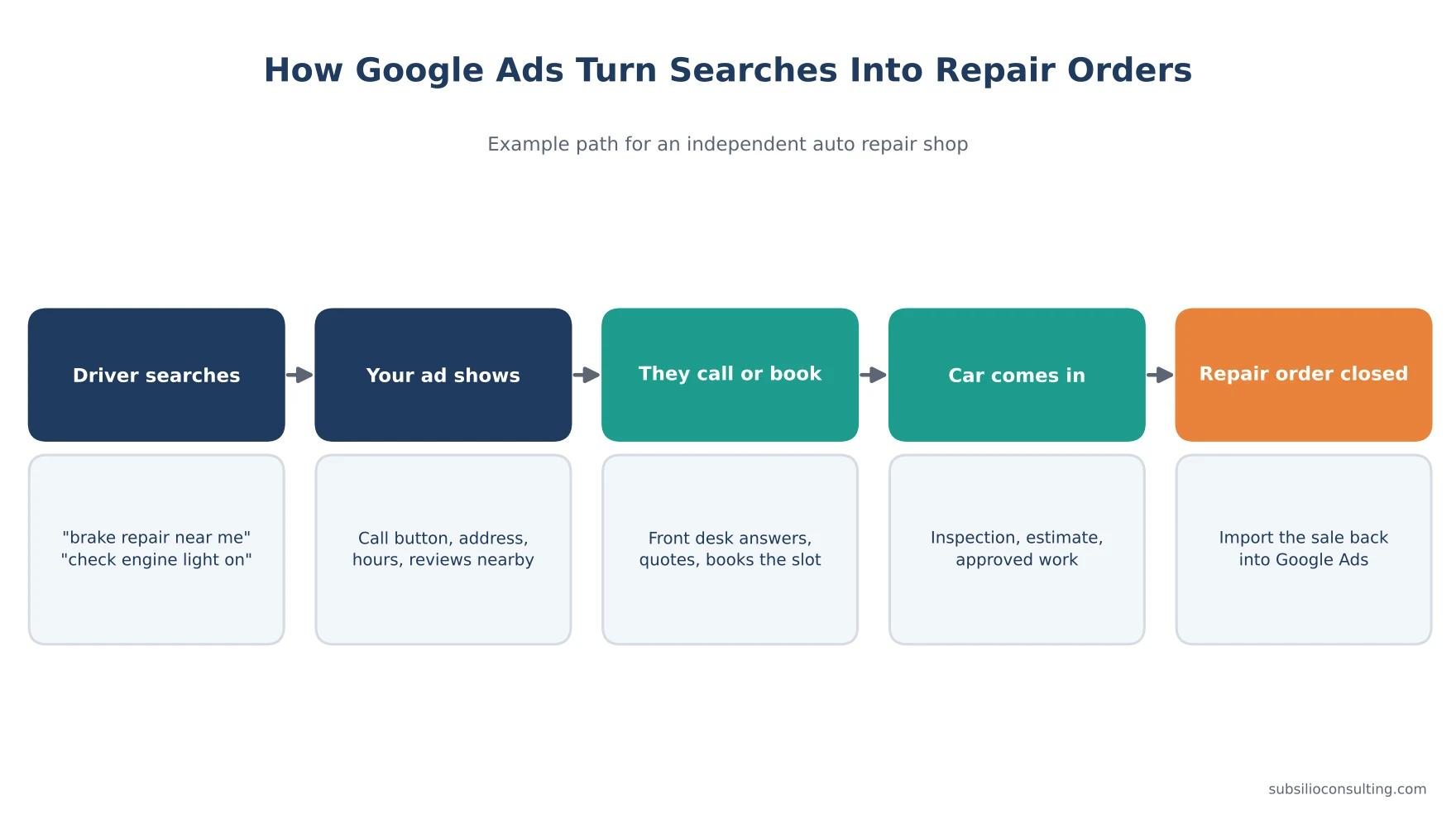
The path from a local search to a closed repair order.
The full path looks like this:
- A driver searches for a problem or service.
- Your ad shows with a call button, your address, hours and links to services.
- They call or book online. Your front desk answers, gives a clear next step and books the car in.
- The car comes in. Inspection, estimate, approved work.
- The repair order closes. Ideally, you send that result back into Google Ads so it learns which searches bring real customers.
Every step matters. Great ads can’t fix missed calls, and great service can’t fix ads shown to the wrong people.
Which Google Ads Campaigns Should an Auto Shop Use?
1. Search Campaigns (Start Here)
Search campaigns show text ads when people search specific keywords. They give you the most control over what you pay for and what message people see. For most independent shops, this should be the core of the account.
2. Local Services Ads
Google Local Services Ads appear at the top of some local searches and charge per lead (calls, messages or bookings) rather than per click. Google’s list of eligible categories now includes auto repair shop, auto body shop, brake shop, oil change service, transmission shop, auto glass repair, tire shop and others, with availability varying by location. Google’s documentation notes that the “Google Verified” badge is currently unavailable for auto categories, so check the current requirements for your area.
In 2026 Google also began moving Local Services Ads into the main Google Ads platform as a pay-per-lead campaign type, so the way they are managed is changing. If you already run them, export your historical reports before your account migrates.
3. Performance Max (Use With Care)
Performance Max shows ads across Search, Maps, YouTube, Display and more using Google’s automation. It can work for shops with strong conversion tracking and good images and video. Without solid tracking, it can spend on low-quality placements. We usually add it after Search is working well.
4. Retargeting
Most visitors won’t book on their first visit. Retargeting shows ads to people who visited your site, reminding them about your shop next time their car needs work. It’s also useful for maintenance reminders.
Keyword Strategy for Auto Repair Shops
Service Keywords
These are your bread and butter:
- brake repair, brake pad replacement
- oil change, synthetic oil change
- check engine light diagnostic, car diagnostic test
- car AC repair, AC recharge
- transmission repair, transmission service
- alignment, suspension repair
- battery replacement, alternator repair, starter repair
- tune up, scheduled maintenance, factory maintenance
- state emissions or inspection services, where relevant to your state
Problem Keywords
People often search the symptom, not the service:
- car won’t start
- grinding noise when braking
- car shaking at high speed
- AC blowing warm air
- car overheating
- check engine light flashing
These can be very valuable, but some come from DIY researchers. Monitor them closely in your search terms report.
Location and “Near Me” Keywords
- auto repair near me
- mechanic near me
- auto repair [your city or neighbourhood]
- brake repair [your city]
You don’t always need to add the city to every keyword when you already target by location, but city-specific keywords can help with ad relevance.
Make and Model Keywords
If you specialise, such as European cars, Japanese imports, diesel trucks, hybrids or a specific brand, these keywords can bring high-value customers with less competition. Only use brand names in a factual way that describes the vehicles you service, and follow Google’s trademark policies.
Use Keyword Planner for Real Numbers
Google’s free Keyword Planner shows estimated search volume and top-of-page bid ranges for your location, which helps you choose services and set budgets.
Negative Keywords Every Auto Shop Needs
Negative keywords stop your ads showing for searches that won’t become customers. Start with a list like this and add more weekly from your search terms report:
| Category | Example negative keywords |
|---|---|
| DIY | how to, diy, yourself, tutorial, video, manual |
| Parts only | parts, part number, wholesale, junkyard, salvage |
| Jobs | jobs, hiring, salary, career, apprentice, school, course |
| Free | free, cheap tools |
| Services you don’t offer | towing, body shop, detailing, car wash (if not offered) |
| Wrong vehicle types | motorcycle, boat, RV (if not serviced) |
Be careful not to block valuable searches. “Cheap oil change” may be a fine search if you run a value offer.
How to Structure Your Account
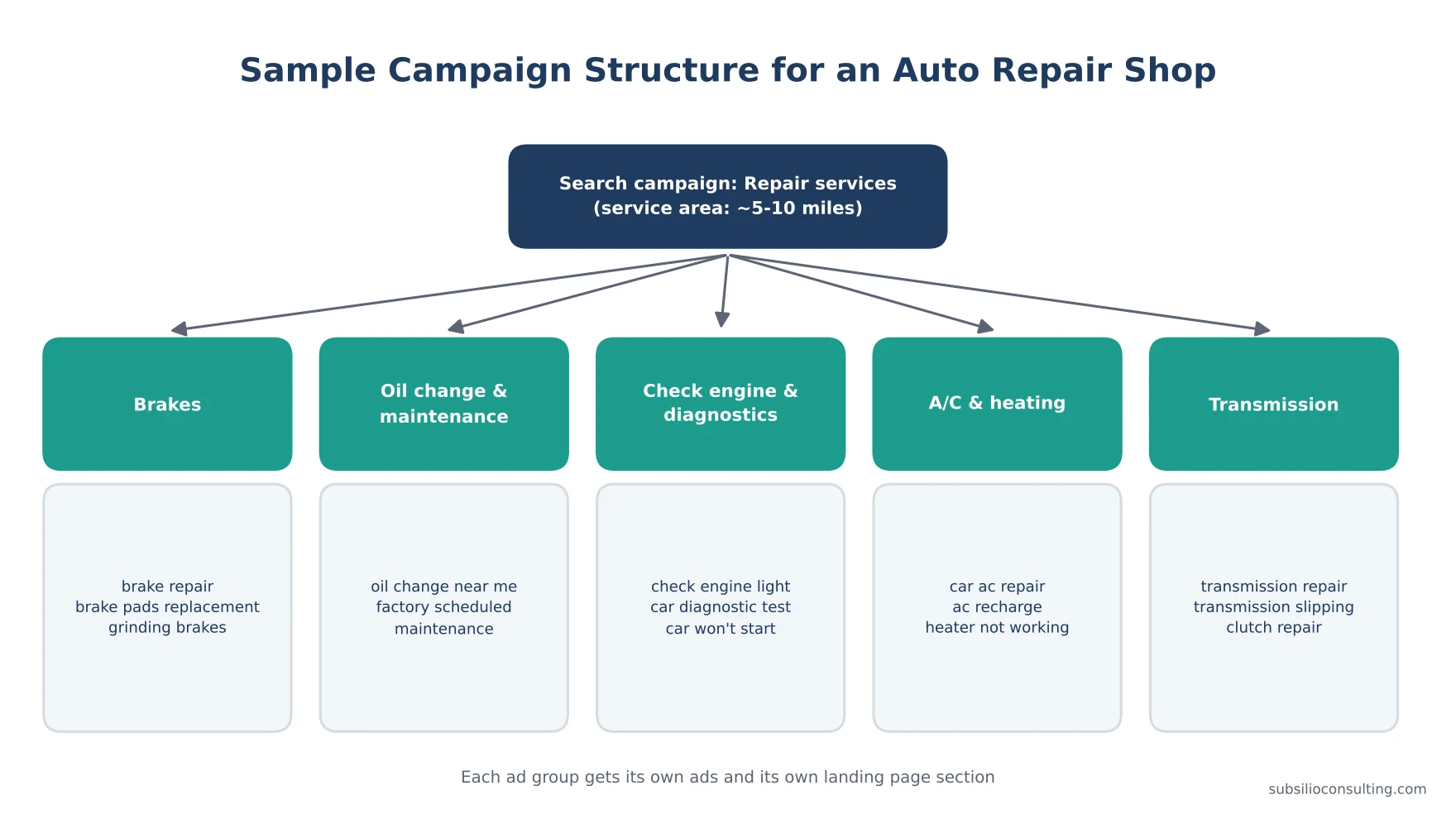
Each ad group gets its own keywords, ads and landing page section.
A simple, effective structure:
- Campaign: Repair Services (Search). Targeting your service area.
- Ad group: Brakes. Brake keywords, brake ads, brake landing page section.
- Ad group: Diagnostics & Check Engine.
- Ad group: Oil Change & Maintenance.
- Ad group: A/C & Heating.
- Ad group: Transmission.
- Campaign: Brand (Search). Your shop name, to protect your brand search and keep costs low.
- Campaign: Retargeting (Display or Demand Gen). Past visitors, with maintenance offers.
Tight ad groups mean your ads can repeat the searcher’s words, which helps relevance and Quality Score. Read our guide on how to improve Google Ads Quality Score and lower cost per click for more on why this matters.
Writing Ads That Get the Call
Google uses responsive search ads, where you provide several headlines and descriptions and Google tests combinations. Give it strong material:
Headline ideas
- Brake Repair in [City] (match the ad group)
- Same-Day Appointments Available
- ASE-Certified Technicians (only if true)
- Free Brake Inspection (only if you offer it)
- Warranty on Parts & Labor (state the real terms)
- Family-Owned Since [Year]
- Call for an Honest Estimate
Description ideas
- Clear, upfront estimates before any work begins. Book online or call today.
- Fast diagnostics with a written estimate. We explain what’s urgent and what can wait.
Tips
- Use the language customers use. “Grinding brakes” beats “brake system service.”
- Mention trust points you can prove: certifications, warranty, reviews, years in business.
- Don’t promise prices you can’t honour. Google’s policies require accurate pricing and terms, and customers will hold you to it.
Add Every Relevant Asset
Assets (formerly extensions) make your ad bigger and more useful:
- Call assets to show your phone number and a call button.
- Location assets linked to your Google Business Profile, showing your address and distance.
- Sitelinks to key service pages and your booking page.
- Callouts like “Free Shuttle,” “Loaner Cars,” or “Open Saturdays” (if true).
- Structured snippets listing services.
Your Landing Page: Where Clicks Become Calls
Sending every ad to your homepage is a common and expensive mistake. Each main service should have a page (or section) that:
- Matches the ad’s promise in the headline.
- Shows your phone number at the top, as a tap-to-call link on mobile.
- Offers online booking if you have it.
- Lists what’s included, warranty details and any current offers.
- Shows real reviews and certifications.
- Shows your address, hours and a map.
- Loads fast on a phone.
If your website needs work, our web design team builds service pages designed for paid traffic.
Track Calls and Repair Orders, Not Just Clicks
For most auto repair shops, the phone is the main lead source. Set up:
- Calls from ads using call assets and a minimum call length.
- Calls from your website using a Google forwarding number for ad visitors.
- Online booking or form conversions.
- Offline imports of booked appointments or completed repair orders where possible.
Google explains the options in its guide about phone call conversion tracking. Our full guide to Google Ads and Facebook Ads conversion tracking walks through each setup step.
Budget: How Much Should an Auto Shop Spend?
There’s no fixed number. Work it out from your own figures:
- Find estimated click costs for your services and area in Keyword Planner.
- Estimate what share of clicks become calls or bookings.
- Work out cost per lead, then cost per new customer.
- Compare that with the profit on a typical first visit, and the lifetime value of a regular customer.
Because a good customer may return for years of maintenance, it can make sense to accept a higher cost for the first visit than a single oil change would justify. Just make sure you’re tracking which services bring customers who come back.
We break down budgeting in more detail in our guide to how much Google Ads cost for small businesses in Denver, and you can learn what fair management fees look like in PPC management pricing.
Don’t Ignore Your Google Business Profile and Reviews
Google Ads and your organic local presence work together. Drivers compare reviews before they call. A strong Google Business Profile with recent reviews and replies helps both your ads (through location assets) and your Map Pack visibility.
- Ask every happy customer for a review. Our guide on how to ask customers for reviews has scripts that work at the counter and by text.
- Reply to every review, good or bad. Use our review response templates.
- Learn how many Google reviews you need to rank in the Map Pack.
Our reputation marketing service helps shops build this on autopilot.
Common Google Ads Mistakes Auto Shops Make
- Targeting too wide an area. Paying for clicks from drivers who’ll never come in.
- One ad group for everything. Generic ads with low relevance and higher costs.
- No negative keywords. Paying for DIY, parts and job searches.
- Sending clicks to the homepage. Making people hunt for the service and phone number.
- Running ads when nobody answers. Missed calls are wasted money.
- Not tracking calls. Seeing “no conversions” when the phone is actually ringing, or the reverse.
- Judging by clicks, not repair orders.
- Letting an agency own the account. You should always own your ad account.
If you’re already running ads and not getting enough calls, work through our Google Ads audit checklist.
Train Your Front Desk: The Missing Piece
Ads deliver the call. Your team wins the job. A few simple habits make a big difference:
- Answer within a few rings, and have a backup for busy times.
- Ask how the caller found you, and note it.
- Offer the next available slot instead of a vague “come by sometime.”
- Call back missed calls fast.
- Log outcomes so you can see which campaigns bring booked work.
Conclusion: Win the Search, Then Win the Customer
Google Ads can give an independent auto repair shop a steady stream of customers who need work done now. The shops that win aren’t the ones that spend the most. They’re the ones that target the right services in the right area, write ads that match what drivers search for, send clicks to clear service pages, track every call, and answer the phone.
Start with a focused Search campaign, build service-based ad groups, add negative keywords and call tracking, and measure success by repair orders. Then grow from there.
Subsilio Consulting helps auto repair shops and other local service businesses get more calls from Google Ads and digital advertising. Book a free consultation and we’ll review your current ads or plan a new campaign for your shop.
Ready to Fill More Bays With Google Ads?
We build Google Ads campaigns for local service businesses that are measured by calls and booked jobs, not clicks.
Frequently Asked Questions About Google Ads for Auto Repair Shops
Q1. Is Google Ads worth it for auto repair shops?
Yes, for most shops. People search when they need car repairs, so Search ads reach drivers at the moment they’re ready to book. It works best with a tight service area, service-specific ads, good landing pages, call tracking and a team that answers calls promptly.
Q2. How much should an auto repair shop spend on Google Ads?
It depends on click costs in your area, how many clicks become calls, and how much a new customer is worth over time. Use Google Keyword Planner to estimate click costs, then work out the budget needed to reach your target number of new customers.
Q3. What are the best keywords for auto repair Google Ads?
Service keywords (brake repair, oil change, AC repair, transmission repair), problem keywords (car won’t start, check engine light), and “near me” or city keywords usually perform best. Add negative keywords to block DIY, parts and job searches.
Q4. Can auto repair shops use Google Local Services Ads?
In many areas, yes. Google lists auto repair shop, auto body shop, brake shop, oil change, transmission, tire and auto glass among its Local Services Ads categories, with availability depending on location. Local Services Ads charge per lead rather than per click.
Q5. Should I use Performance Max for my auto shop?
Performance Max can work once you have reliable conversion tracking and good images or video. Most independent shops get better control and results by starting with Search campaigns, then testing Performance Max later.
Q6. How do I track phone calls from Google Ads?
Use call assets with call reporting to track calls from ads, add Google’s website call tracking to track calls from your site, and set a minimum call length so short calls aren’t counted as conversions.
Q7. How fast will I get calls from Google Ads?
Ads can start showing soon after approval, and many shops receive calls in the first week. It takes longer, usually several weeks of data, to refine keywords, ads and bids for the best cost per customer.
Q8. Should I advertise by car brand?
If you specialise in certain makes, factual brand-related keywords can bring high-value customers. Follow Google’s trademark rules and don’t suggest you’re an official dealer unless you are.